Switzerland's solar railway works — and HN's napkin math says 44 km of it moves one locomotive
The world's first solar railway laid 48 panels between the rails and ran for a year. The feel-good headline meets a thread of engineers who reach for a calculator and find the energy density brutal.
Swiss startup Sun-Ways put 18 kWp of panels across 100 m of track in Buttes, producing ~16,000 kWh/year, and the trial went well enough that a permanent install looks likely, with Italian and other partners lining up.
The thread does the arithmetic: 18 kW over 100 m is less than a big house rooftop, you'd need ~44 km of track to power one locomotive — and the reply is that efficiency was never the point.
The trial: panels between the rails
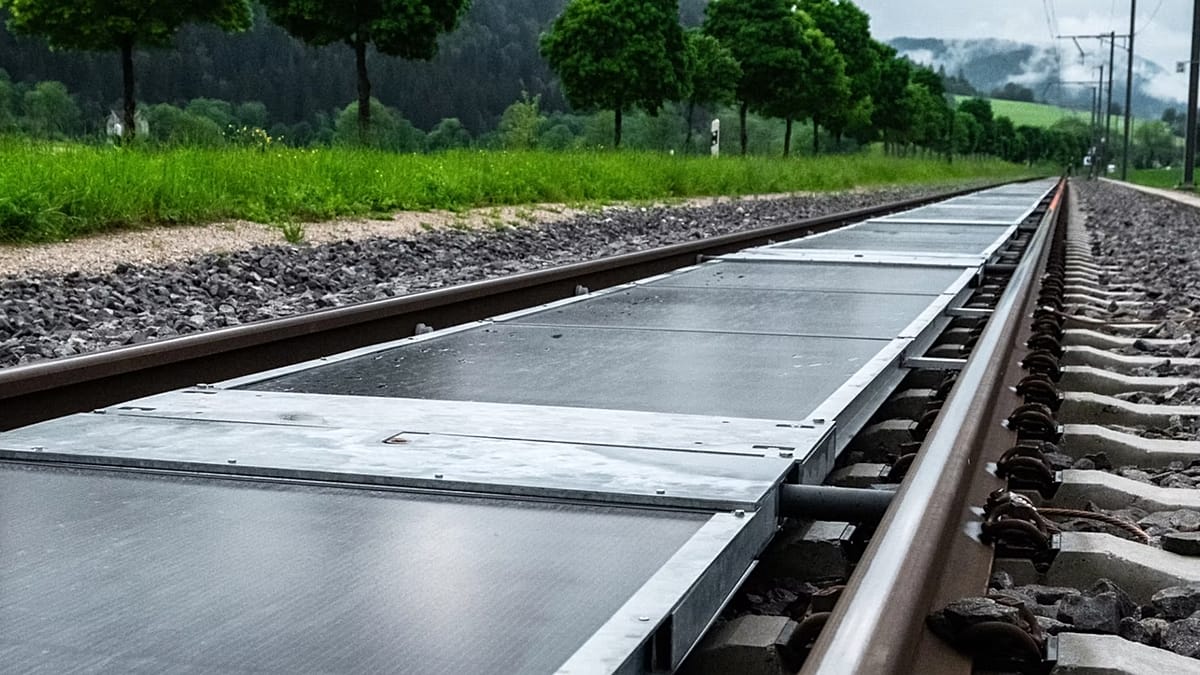
Euronews reports that Swiss startup Sun-Ways ran the world's first solar-railway trial in Buttes: 48 panels, 18 kWp combined, laid over a 100-metre stretch between the rails, producing about 16,000 kWh/year despite a ~10% loss from the flat mounting angle. After one year of a planned three-year trial, results looked good enough that a permanent installation seems likely; Sun-Ways has a deal with an Italian partner tied to the national rail operator, South Korean approval, and talks with Dutch, Chinese, Indian and Singaporean partners. Scaled to Switzerland's ~5,317 km network, the article claims about 1 TWh/year, roughly 2% of national consumption.
The thread is a clinic in why "it works" and "it's worth it" are different sentences.
The calculator comes out
"18 kW is less than what gets installed on a lot of houses. It took 100 meters to do this. The farther the panels get from the interconnect, the higher the losses along the line… I really wish we could just forget all of these ideas to put solar panels in places that are highly trafficked and serving double duty." — a very high-karma commenter
Then someone turned the brochure number into a fleet number:
"18kw/100 m = 180kw/km … The most powerful Swiss electric locomotive maxes out at 7900kw. That's 44km of track … that's 300 electrical locomotives running simultaneously. The Swiss fleet is about four times that." — a commenter working off the Swiss rolling-stock list
The engineering advice that follows is almost paternal — stop bolting solar to moving things:
"Solar cell is the only practically viable power source with no moving parts. Stop trying to attach it to moving things. Movements breaks things. Just put the panels by the rail" — a developer arguing for trackside panels
The defense that reframes the whole thing
The pushback to the pushback is the actual thesis, and it's fair:
"This is a great example of the solar ecosystem finding new niches… The point here isn't that this is 'the most efficient way to use solar' it is that it works and provides benefit. It is like agrovoltaics." — a commenter arguing the dual-use case
So both sides are right, which is the useful conclusion. As a plan to power the railway, the math is unkind — you'd pave the whole network to run a fraction of the fleet. As a way to monetize land that's already graded, fenced and wired, between rails that would otherwise grow weeds, it doesn't have to win on efficiency. The mistake is only in the headline that implies the trains will run on it.
Get breakdowns like this every day
The top Hacker News stories, unpacked — by email, Telegram, or RSS.
shadcn didn't ship a codemod for the Radix-to-Base-UI switch — it shipped an LLM "skill" instead
The changelog buries the interesting part. To move a component off Radix you no longer run a codemod — you install a "skill" and tell an agent to migrate it. And commenters immediately clock that the release note itself reads like Claude wrote it.