Anthropic's Product Chief Quit Figma's Board Days Before a Rival Launch
On April 14, Mike Krieger, Anthropic's chief product officer and an Instagram co-founder, quietly resigned from Figma's board. Three days later, Anthropic shipped Claude Design, a tool that let anyone generate the prototypes and pitch decks Figma had built its business on. Figma's stock dropped by the end of the day.
The essay under discussion ranks Anthropic as the most exposed frontier lab of all: it rents every data center and power plant it uses, and Fable costs nearly three times as much per completed task as OpenAI's models do, according to the Artificial Analysis benchmarks it cites.
The sharpest pushback on HN wasn't about that cost math — it was that Anthropic's own scramble for a product moat is what blew up the Figma partnership in the first place.
Three ways to run a frontier lab, and only one of them scales

The essay behind this week's top HN thread, posted by a markets analyst, sorts AI companies into three groups by how they pay for compute. Anthropic, Moonshot, and Knowledge Atlas lease their data centers and electricity, so every dollar of growth costs roughly the same dollar of infrastructure: margins don't improve with scale. Meta and Alibaba own their data centers outright, so fixed costs shrink as a share of revenue the more they grow. SpaceX goes one step further and owns the power generation too, squeezing margin at every layer of the stack.
The trigger for the piece was this week's releases of Kimi K3 and Qwen 3.8, open-weight models that put Moonshot and Alibaba within striking distance of Fable and GPT-5.6 on benchmarks. If a lab renting someone else's GPUs at someone else's negotiated rate can match a lab with the best model, the argument goes, that model was the only real defense Anthropic had, and it just got thinner. The essay backs this with one hard number:
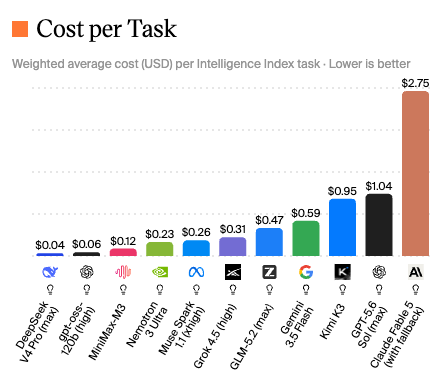
Fable costs nearly three times as much per completed task as OpenAI's models, per the Artificial Analysis data the essay cites. OpenAI, in its telling, escapes Anthropic's fate because it has spent the past year building "clearer moats" elsewhere: voice, consumer hardware, site publishing. Anthropic, by contrast, has mostly bet on having the best model. Barring regulatory intervention or an actual AGI breakthrough, the essay's verdict is blunt: Anthropic is the most exposed lab on its list.
A reader asked why OpenAI isn't "model-only" too. The essay's author answered.
The top-voted reply in the thread went straight at the essay's central distinction: if Anthropic is vulnerable because it only sells a model, why isn't OpenAI, which also mostly sells a model? The essay's author, replying under the same account that submitted the piece, didn't retreat from the comparison:
"They are trying to diversify into consumer hardware and also are further along in owning data centers. The consumer hardware product, assuming it launches and does decently well, puts them in a very unique position relative to pretty much every other frontier lab." — the essay's author, cl42
Not everyone bought it. One reply noted that the essay's own list of OpenAI's advantages, "product, consumer experience, site publishing, voice, and hardware," is mostly unproven, especially the hardware, which hasn't shipped a single unit yet.
The moat, some argue, was never the model. It's Excel.
A commenter who runs an ML-focused markets newsletter offered the thread's most cited counter-argument: the model itself is a small part of what people are actually paying for.
"Anyone that tried to build agentic solutions from LLM apis quickly realizes that a huge value is the Claude Code / Codex harness… Consider how much money Microsoft spends on maintaining Excel. There are open source alternatives that have >90% of the functionality… But the immense value spreadsheet software produces… makes it so that there is a real moat and no one bothers exploring alternatives." — a commenter who runs an ML-focused markets newsletter
That argument only holds if the harness gap is durable. A developer who'd used Claude Code as his daily driver since Opus 4.5 shipped in late 2025 wasn't convinced it still is:
"In November of 2025, I would have said that Anthropic's Opus 4.5 model together with their Claude Code harness was the first and only system where a well-specified software feature could be implemented correctly for me in one shot. Today, I'm about equally happy to use Claude or Codex." — a developer who'd used Claude Code daily since Opus 4.5 shipped
What actually broke the Figma partnership
Buried deeper in the thread is the reversal that has nothing to do with model pricing and everything to do with how a product moat can backfire. Krieger had sat on Figma's board since Anthropic's models started powering Figma's own AI features. Three days after he quietly stepped down, Anthropic launched Claude Design, letting anyone generate the prototypes and pitch decks that had been Figma's territory. Figma's stock fell between 6% and 7.7% the day it went live.
"I would suggest to people using LLMs: you should be cautious about giving these companies data or relying on them. If you're building an AI startup, there's a very good chance they could decide to directly compete with you if your idea has traction." — a commenter who laid out the board-resignation timeline in detail
It's the essay's OpenAI-has-better-moats argument turned inside out: Anthropic did try to build one, and building it looked enough like insider dealing that a partner lost a chunk of its market cap in one afternoon.
The distillation accusation nobody can quite prove
Anthropic has previously suggested that Chinese labs owe some of their catch-up speed to distilling from its models, training on Fable's outputs rather than from scratch. The thread wasn't buying it without evidence.
"The frontier labs have been tightly controlling model access lately to prevent further distillation, and the Chinese labs are still catching up rapidly - it's likely that whatever moat they used distillation to overcome early on is already dry" — a former Big Tech engineer
Intel versus Arm, again
The thread's last turn circles back to the essay's own framework. If the model layer really is commoditizing, the endgame might not be about who owns the best weights, but who burns them into silicon first: a chip that runs one frozen model at 9,000 tokens per second instead of 150.
"This is starting to look at a lot like Intel vs Arm from the last era. The Fable & Mythos are starting to look like a giant Xeon, while the smaller lighter models are starting to look like a lot of tiny ARM chips which sip on power instead… Follow them and they lead you to a pile of money, but then you risk something like Apple Silicon happening." — a PHP core contributor
That's the essay's infrastructure argument again, one layer down. Owning the data center wasn't the last mile after all; owning the chip that runs your one model, cheaper than any GPU, might be.
Get breakdowns like this every day
The top Hacker News stories, unpacked — by email, Telegram, or RSS.
A tweet says Claude Fable just broke an 87-year-old math conjecture
Mathematician Levent Alpoge posted a counterexample on X, crediting a friend named Akhil and the AI model Claude Fable with disproving the Jacobian Conjecture. No journal, no arXiv preprint: mathematicians picked it apart in the replies within hours.