A map claims 2,438 world castles; readers found most of theirs missing
Thecastlemap.com sorts its landmarks by a "fame" score. That score turns out to be nothing more than how many Wikipedia language editions cover each place, pulled from Wikidata's own sitelink data, which is why entire regions came up nearly empty once readers checked.
Readers ran the numbers on their own countries: Saxony alone has 700-plus historic fortifications against nine pins on the map; France counts roughly 180 listed castles against an estimated 45,000 nationwide.
One commenter guessed the map was only reading English-language Wikipedia before anyone confirmed it. Then the site's solo builder turned up in the replies, admitted the whole thing was built in a weekend, and promised to actually fix it.
Why a "fame ranking" of castles is actually a ranking of Wikipedia coverage
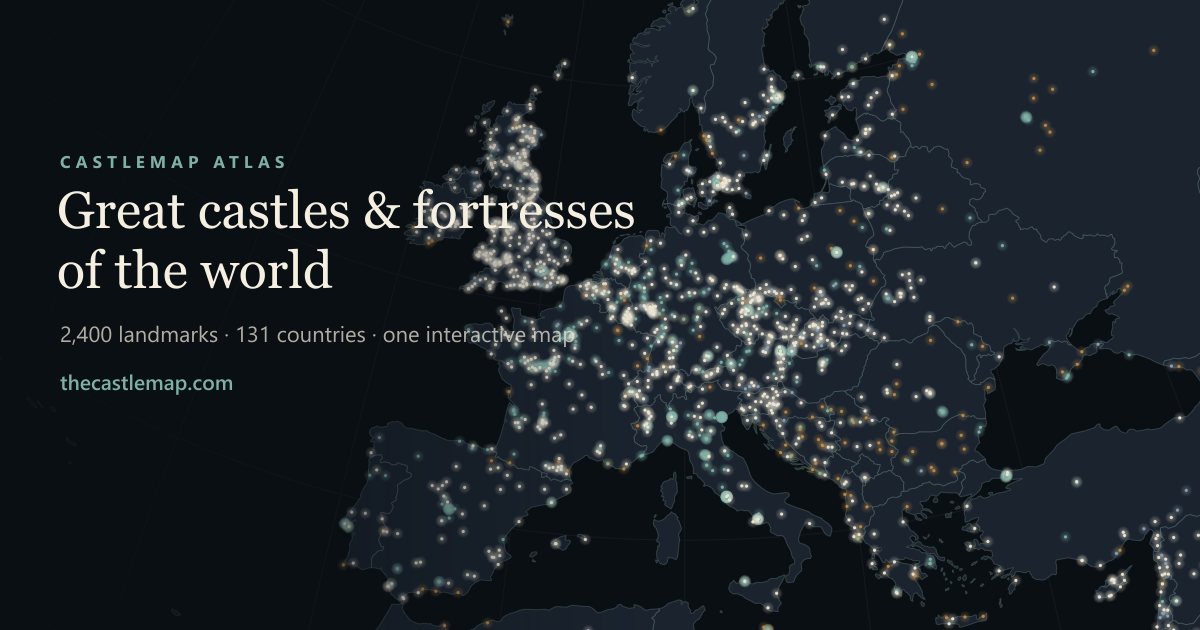
Thecastlemap.com is a free interactive atlas of the world's castles, fortresses and palaces: 2,438 of them across 130 countries, broken down on the site as 940 castles, 390 fortresses, 690 palaces and 418 ruins. Every entry draws on Wikidata for facts and coordinates, Wikimedia Commons for photos and Wikipedia for the write-up, and the whole dataset is downloadable as GeoJSON or CSV under a CC0 license.
The map's central feature is its "fame ranking." Pins are sorted by a fame score that the site defines as the number of Wikipedia language editions, plus a few sister projects, covering a given landmark, taken from its Wikidata sitelink count. Versailles comes out on top by that measure. It's a documented methodology, not a hidden one: the site says so upfront. What isn't upfront is how much that number depends on which language wrote about a place first, something the thread would spend the next several hours proving, country after country.
Readers checked their own backyards, and the gaps piled up fast
The 134-comment thread turned almost immediately into a running country audit. A reader who knows Saxony put the local math next to the map: the region alone has 700-plus historic fortifications, roughly a hundred of them worth visiting; the map shows about nine. Ireland, Hungary, Switzerland, Portugal, Ghana's coastal forts, Italy's Lerici region: the same complaint recurred, country after country, for most of the thread.
One reader reduced it to five words: "Wrong title. Wrong not even by two orders of magnitude." It got a deadpan reply from another commenter, who wondered aloud if the site thought there were only twenty castles in the world, total.
The mechanism, guessed at before anyone confirmed it
A commenter counting his own country's shortfall put a number on it first: the map listed "180ish" French castles against an estimated 45,000 in reality. Then he went further, guessing at the mechanism before anyone confirmed it: "I wonder if it's only scraping english language Wikipedia articles?" The guess landed. An investigative data journalist traced the actual cause to Wikidata's own tagging, comparing two comparable fortifications directly: Bran Castle, filed under "castle," and Citadel Hill in Nova Scotia, filed under a different category and therefore invisible to the map's query. The site isn't missing castles because they don't exist; it's missing whatever Wikidata's editors, writing mostly in English, never got around to tagging the same way.
The builder logs on: "I did not want to focus too much on this website"
Flightmussy confirmed in the thread that he built and runs the site alongside three other side projects, and hadn't planned on defending it:
"I did not want to focus too much on this website due to what I thought of a market of low demand. However, there are so many critical comments. Hence, I will fix it properly and this will be one of the websites I will fully commit to."
— Flightmussy, the site's solo builder, replying in the thread
A few replies later he was just as direct about how it got built in the first place: "Yes this is vibe coded and the focus was to create a concept to see if the site had potential."
What "fame" forgot: the Acropolis isn't on the map
The sharpest catch came late in the thread, from an HN veteran with more than 24,000 karma who went looking for the one landmark a fame ranking should have made undeniable:
"It's missing the Acropolis. The Acropolis, in Athens. There's no more famous castle than that. Or fortress, whatever you want to call it. … This will take serious effort to fix if it's so deficient it doesn't include the most famous castle of all."
— an HN veteran with 24,000-plus karma
By any definition of fame that predates Wikidata, the Acropolis should be pin number one, not a gap in a query. The map isn't really ranking the world's fortresses — it's ranking how thoroughly Wikipedia's editors have already ranked them, and wherever their attention runs thin, so does the map.
Get breakdowns like this every day
The top Hacker News stories, unpacked — by email, Telegram, or RSS.
Fireworks Says Its Router Sent 96% of Tasks to Kimi K3, Not Fable
Fireworks AI ran 1,030 real coding, legal and terminal tasks through Kimi K3 and its own hosted model Fable, then simulated a router that always picks whichever one solves a task correctly for less. In the company's own write-up, a Fable win reads as a 'dead heat' and a Kimi win just reads as 'Kimi wins.'