Loudoun County has 176 data centers. Its teachers just got a 40% raise, funded by them
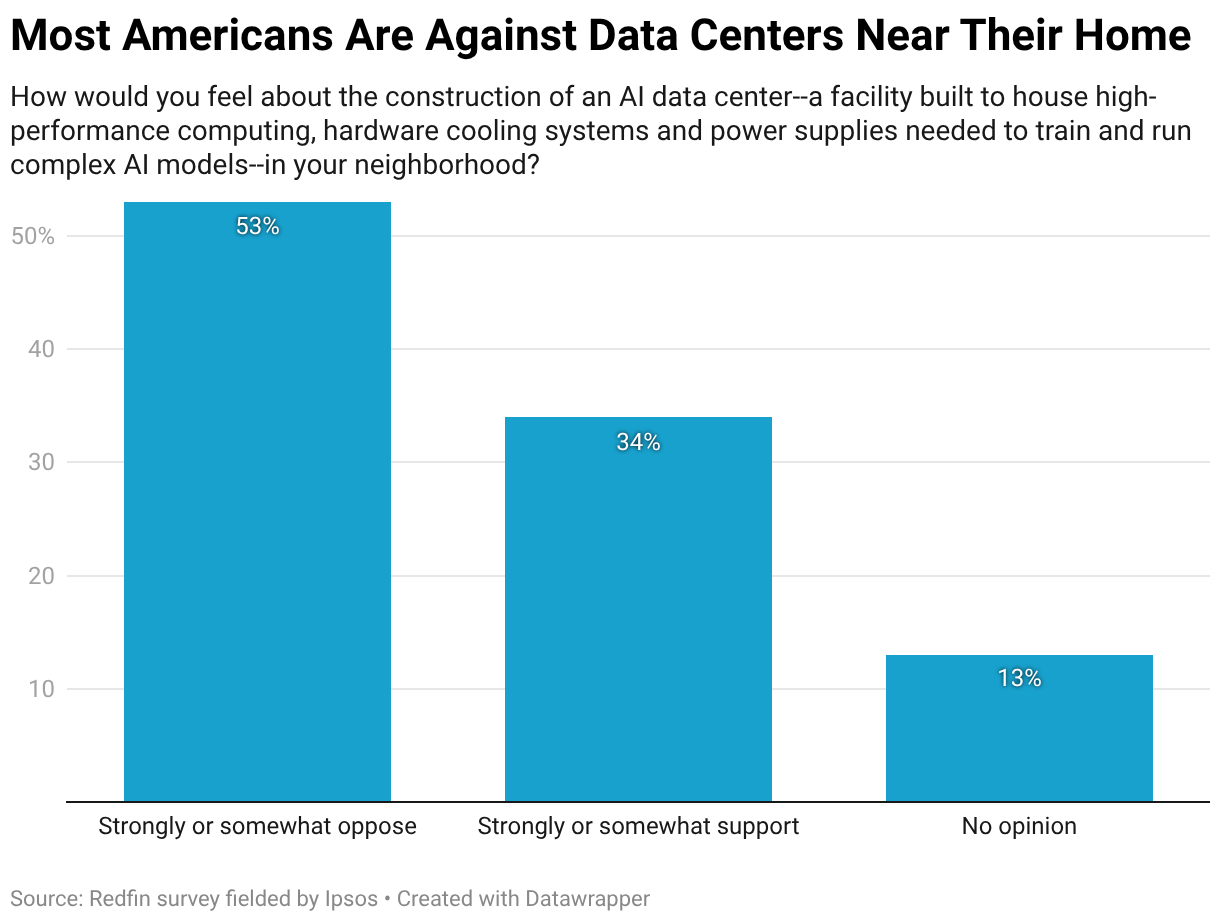
53% of Americans oppose a data center in their neighborhood, more than any other kind of new construction. But Redfin's own tax-record analysis of the county with more AI data centers than anywhere else in the US found education spending up 82% — without raising a single homeowner's tax rate.
A Redfin survey of 4,000 Americans found 53% oppose new data centers nearby — more resistance than apartments or mixed-use development draws. Baby boomers oppose them 65% to 34%; Gen Z splits closer to even at 42%.
Redfin's own county tax-record data cuts the other way: Loudoun County, VA — 176 data centers, the most in the US — saw education spending per resident jump 77% and teacher pay rise roughly 40%, funded entirely by data centers' property taxes.
A resident with 9,000+ karma who lives near several data centers: the backlash isn't really about the old, quiet ones — it's the new generation, built at a scale that didn't exist five years ago.
The opposition number, and what's actually driving it
Redfin's May 2026 survey of 4,000 US residents, conducted by Ipsos, found that 53% oppose building a data center in their neighborhood, against 34% in support — a wider opposition margin than apartments (39% opposed) or mixed-use development (32% opposed) draw from the same population. The resistance skews sharply by age: 65% of baby boomers oppose data centers, versus 60% of Gen X, 43% of millennials, and 42% of Gen Z. Fifty-eight percent of all respondents said they believe AI's advance will "eliminate jobs and make it harder to afford homes" — the opposition isn't purely about noise and traffic, it's tangled up with broader anxiety about what the industry building these buildings is doing to the economy.
The stated local concerns are concrete: strain on electricity and water supply, constant industrial noise, an unattractive footprint, and fear that the jobs a data center brings don't offset what it costs the neighborhood in services and quality of life.
The county where the opposite happened
Redfin's second dataset, pulled from county financial records rather than survey responses, complicates the opposition story. Loudoun County, Virginia — home to 176 data centers, more than any county in the country — saw personal property tax revenue climb 639% between 2010 and 2025. That revenue didn't sit in a reserve fund: education spending per resident in the county rose 77% to $2,955, and teacher salaries climbed roughly 40% to around $83,000 — all funded by taxes the data centers pay on their own equipment, not by raising rates on homeowners. Prince William County, with 77 data centers, shows the same pattern at smaller scale: personal property tax revenue up 349%, education spending per resident up 82% to $1,589, and residential property tax rates that actually fell, from $1.12 to $0.92 per $100 of assessed value.
The two counties with the densest data-center buildout in America didn't just avoid the fiscal strain critics warn about — they used data-center tax revenue to cut homeowners' bills while raising teacher pay.
Not all data centers are the same building
The sharpest reframe in the thread came from a longtime commenter with over 9,000 karma who lives near several data centers: "I think the biggest change in public sentiment in datacenters is a reaction to the extreme scale they're being deployed at these days. They're really vastly unlike datacenters of the past." They linked two real buildings by way of contrast — one an unremarkable office-park structure nobody would clock as a data center, the other an obvious industrial monolith with on-site power generation installed without air-quality review, drawing groundwater at a rate that alarms neighbors. "A quiet, average-sized warehouse-like building... often didn't bother a lot of people... A giant monster of a building... is a whole different story." Their point: the survey measures opposition to "data centers" as a category, but the buildings driving today's backlash are a genuinely new physical scale — bigger footprints, denser power draw, faster permitting, fewer environmental reviews — than the quiet suburban server farms that coexisted peacefully with residents for two decades.
Seen through Loudoun and Prince William counties' books, the opposition and the benefit aren't actually contradicting each other — they're describing two different eras of data center. The fiscal windfall came from an earlier, smaller-scale buildout. What's provoking 53% opposition today is the AI boom's new generation: bigger, louder, thirstier for water and grid power, and moving into backyards at a pace zoning boards haven't caught up with.
Get breakdowns like this every day
The top Hacker News stories, unpacked — by email, Telegram, or RSS.
Codeberg's ban on crypto projects merged the same week it banned AI-generated code
A one-line addition to Codeberg's terms of use now forbids anything that "harms the reputation of Codeberg, such as — but not limited to — cryptocurrency related projects." It passed the same week the nonprofit banned vibe-coded submissions, and neither ban defines its own target.