He charted seven years of GitHub activity. AI made 2026 his busiest year since 2020
Orestis Ioannou expected AI agents to give him his afternoons back. His own contribution graph says August 2026 was the busiest month of his career: 427 contributions.
Ioannou, an engineer at Bold.org, pulled his GitHub history and found his median weekday had gone from 3 or 4 contributions to 7. Days with no activity fell from 40 to 46 a year to 18 so far. He blames cheap starts: agents make every new project easy to begin and hard to put down.
The thread's sharpest reply came from commenters who think he misread the deal from the start.
Cheap to start, impossible to put down
Orestis Ioannou says AI tools were supposed to cut his workload and instead left him working more and feeling more tired. Agents let him run many projects at once, and each one needs his attention in bursts. That switching between repositories and decisions wears him out more than the two or three focused tasks a week he handled before.
To test the feeling, he went through his GitHub contributions from 2019 to October 2026. As a Full Stack Engineer his months mostly ran between 130 and 320, peaking at 319 in April 2020. As a Principal Engineer they dropped to roughly 55 to 200. Then 2026 jumped.
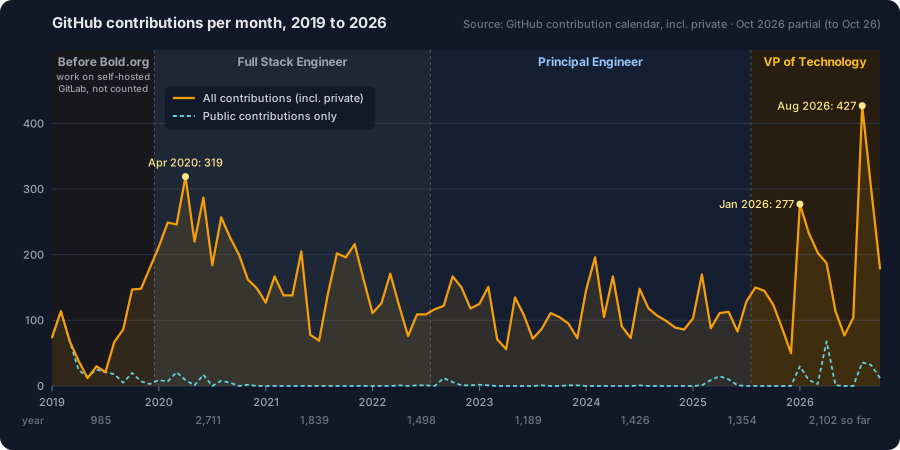
His 2026 total hit 2,102 by October 27, close to the 2,711 of 2020 and above every full year from 2021 to 2025. August 2026 reached 427, his record month. He describes three "bursts" this year, each followed by fatigue and a pullback, and says his capacity to implement ideas now outruns his capacity to think them through.
"What kind of illusion" assumes employers pay for less work
The top reply attacked the premise before the data. The first commenter wrote:
"The opening premise baffles me. What kind of illusion must one be under to believe that employers would ever pay you the same amount of money to do less work?"
Another voice supplied the economics. A commenter who goes by Zak put it in one line:
"A rational employer is interested in how much value they can get, not how hard you work."
A third commenter dated the problem:
"Workers are under the perennial illusion that they'll ever benefit from productivity gains, but that hasn't been the case since the 1970s."
The tractor argument, and the people who walked away
One commenter reached for farming: if you go from horse to tractor, the fields get bigger but the hours don't shrink, and whoever stays on the horse gets undersold. Another noted that people can organize through unions or the polls and push for fewer hours, since nothing but that fight keeps anyone off a seven-day week.
Then came the counter-testimony. Planning scientist jvanderbot, formerly at NASA JPL and Amazon Robotics, said AI wiped out his most tedious work and gave him a tight feedback loop that makes the day easier, with the caveat that making longer hours mandatory would be a bad thing. One commenter described handling CRM and accounting chores by voice on a barefoot walk along the beach, and another answered that soon we can all be doing outstanding CRM tasks instead of wasting time enjoying nature.
The disagreement is not about whether AI speeds work up. It is about who keeps the saved hours, and so far the people who describe keeping them are the self-employed.
Get breakdowns like this every day
The top Hacker News stories, unpacked — by email, Telegram, or RSS.
Python's JIT shipped in 3.13, and its own authors just withdrew the PEP that would keep it
Three core developers wrote PEP 836 to save CPython's experimental JIT. After the steering council called their review date "way, way too late", they withdrew it for lack of bandwidth.