Ethan Mollick let Claude work for 9.5 hours on its own. Engineers shipping AI to users were horrified
His thesis: you no longer steer the model, you commission it like a studio. One run researched 2,200 flights and produced a 19-page design doc. The thread's working developers saw a metric pointing the wrong way.
The pitch is a role change — judge the finished work, don't drive the process. One project ran nine and a half hours nearly unattended.
Practitioners flipped it: their customers are begging for sub-20-second agents, so a 9.5-hour run is a warning, not a wonder.
And the showcased travel-time map, checked against Google Maps, routed people down roads that don't exist.
"I no longer steer; I commission"
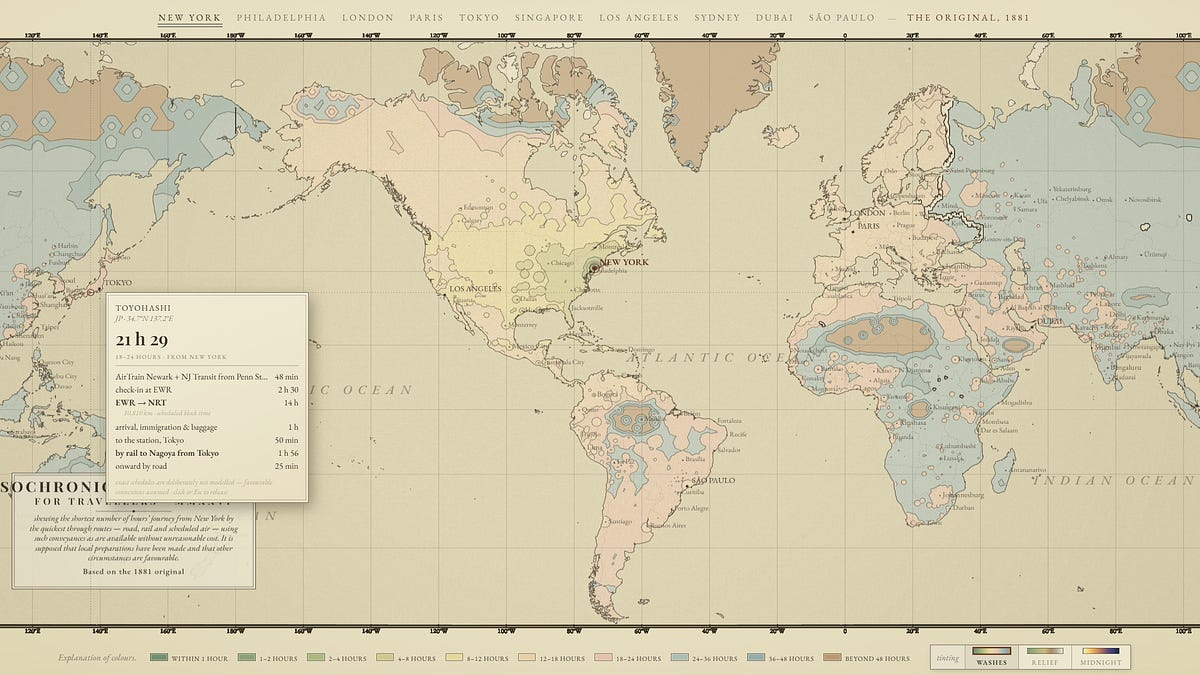
Ethan Mollick's piece argues that Anthropic's Claude 5 marks a shift in how humans work with AI: you stop steering a tool and start acting like a patron commissioning work from an autonomous studio, judging only the final output. He reports giving an ambitious instruction and watching the model work largely on its own — one project ran continuously for 9.5 hours, researched 2,200+ specific flights, and produced a 19-page design document, with his role "extremely limited." He praises it as outperforming prior public models by a considerable margin, while flagging real costs: roughly twice the price of Opus, heavy token burn, and over-sensitive safety guardrails that default to weaker models too often. Named outputs include an isochrone travel-time map mimicking an 1881 original, and research software he calls "Concord."
▶ Try Mollick's isochrone travel-time demo
The flagship stat, read as a red flag
To people who run agents in production, "9.5 hours unattended" isn't a feature.
"It worked for nine and a half hours … My customers are currently clamoring to push down my agent response times from 85 seconds down to below the 20s mark." — a developer running latency-sensitive agents
Others were genuinely staggered in the other direction:
"I know no single dev who could create what it did (Concord), from a 19-page design document, in 9.5 working hours … instead of saying 'compiling,' we'll just say, 'waiting for Claude.'" — matneyx, a full-stack developer
The guardrails defeat the use case
The recurring complaint matched the other Fable threads: the model bails to Opus exactly where you needed its extra capability.
"Fable burned through 16% of my weekly quota in a 40 minute code review session. It didn't even finish the review, it switched back to Opus 4.8 in the critical memory safety parts where I actually needed Fable." — matheusmoreira, creator of the 'lone' language
A growth-equity VC who liked the model still clocked the burn rate (on the quota).
"Looks correct but is not"
The most useful skepticism came from someone who checked the showcased demo against reality.
"It looks interesting but, like a lot of AI, looks correct but is not. Most of northwestern Canada says you can get there by road … there's no roads there for quite awhile." — a commenter who compared the isochrone map to Google Maps
That's the tension the post embodies. The same nine-and-a-half-hour run that feels like the future to a professor judging a finished artifact looks like an unshippable latency-and-cost problem to the engineer who has to put it in front of users — and the showcase artifact, examined closely, confidently routes you through roadless wilderness.
Get breakdowns like this every day
The top Hacker News stories, unpacked — by email, Telegram, or RSS.
Why has nobody dethroned Ticketmaster? Because you and I were never its customers
An HN user watched a $2,000 Knicks ticket resell past $10,000 and asked why no competitor exists. Someone who spent years at a rival explained the trap — and why the fees are a feature for everyone but fans.