A one-page manifesto says open AI must win. The thread asks: win what, paid by whom?
The site is a single plain-text page with one demand and one call to action: email the author. It argues that if intelligence becomes something you can only rent, the public loses not software freedom but operational freedom.
The pitch landed on raw nerves the weekend a government switched off a frontier model: keep AI usable, auditable, locally deployable, community-governed, or live inside a subscription economy for cognition.
Readers who share the sentiment took apart the words. If a model runs on hardware you don't control, one developer asked, in what sense is it open — and who funds the next training run when 'open' means nobody charges?
The whole argument fits on one screen
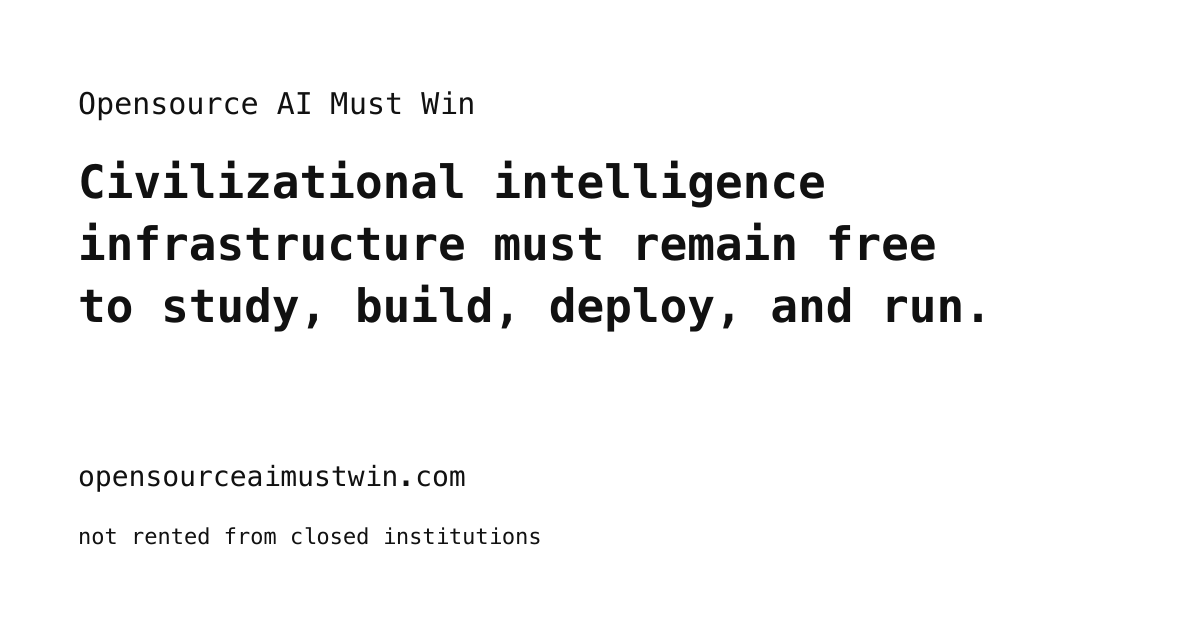
Open source AI must win, a manifesto by Ahmad Osman, is served as a single dependency-free page. Its claim compresses to one sentence: "If intelligence becomes something people can only rent from a few closed institutions, the public does not just lose software freedom. It loses operational freedom." From there it lists the capabilities people must retain — to study, build, repair, deploy, audit, adapt, teach, preserve, and run AI themselves — and frames the whole thing as civilizational infrastructure. The call to action is disarmingly small: email the author. There is no roadmap, no named model, no funding plan.
It hit the front page hard, and it did so the same weekend the U.S. ordered Anthropic's Fable 5 disabled — which is most of why a vague manifesto drew over 1,500 points. The thread agreed with the mood and then went after the text.
"Open" is doing two different jobs
The sharpest objections weren't against the goal but the vocabulary. A model you download but can't reproduce or control isn't "open source" in the sense the words usually carry:
"any AI system that runs on a computer that i do not control is by my definition not Open Source. so how then can Open Source AI win? it can't even compete… what exactly is the demand here?" — a developer and CTO-for-hire poking at the definition
"Can we assume that the author isn't using 'Opensource' to mean 'Openweights'? Or are we still collectively brainwashed by the strategic false equivalence established by Big AI CMOs?" — a commenter with 43k karma on the open-weights sleight of hand
That distinction is the crux. Open weights let you run and fine-tune a model; they don't hand you the training data, the pipeline, or the ability to rebuild it. Calling that "open source" borrows the credibility of one thing for another.
Where the leverage might actually be
One reader, a published author on algorithms, moved the argument off the model and onto the scaffolding around it:
"To make any agent 'good,' there are two components: the model and the harness… anyone can build a harness… Can I build a harness that's good enough that I can use open source models with opus level performance?" — a Manning author describing a coding agent he's building
Others doubted "win" was ever the right verb. A blunt historical scoreboard:
"Did open source phones win? No… Did open source operating systems win? No, MacOS/Windows… Does open source cloud hosting, social media, ride sharing apps… win? Not in my experience." — a reader running down the record
And a geopolitical read argued the question is already being settled by someone else's hand:
"Ever since a Chinese firm released DeepSeek I… came to the realization that any US tech firm 'owning' AI is simply not going to happen. China will make sure of it." — a commenter on why no single country locks up the field
A manifesto is a thermometer, not a plan
What the page measures is real: the fear, sharpened by the Fable shutdown, that cognition becomes a metered utility owned by a handful of institutions. What it doesn't supply is the hard part — who pays for the next frontier training run when the deliverable is free, and what "open" has to mean before the word means anything. The most useful thing in 463 comments wasn't agreement with the title. It was the reminder that the lever, if there is one, may be the open harness around the model, not the model itself.
Get breakdowns like this every day
The top Hacker News stories, unpacked — by email, Telegram, or RSS.
A billion-speaker script still can't be justified correctly in any 2026 browser. Here's why
Classical Arabic justifies by elongating letter strokes (kashida), codified around 940 CE — not by stretching word spaces. CSS does the opposite, and the result looks wrong to anyone who reads the script.