A Bayer drug-research AI agent, and the 3.1/5.0 the article left out
Thirty paragraphs detail a multi-agent architecture orchestrating retrieval, reflection, and writing. Two paragraphs cover evaluation. The hard number — how well it meets user needs — appears only in a linked paper a commenter went and read.
PRINCE is a Bayer preclinical-research assistant that grew from keyword search into a conversational agent. Its reliability rests on context engineering (each agent sees only what it needs) and harness engineering (saved state, retries, fallback providers).
The article names RAGAS and faithfulness metrics but reports no accuracy or latency figures of its own.
A reader supplied the missing one from the source paper: an overall capability of 3.1/5.0 — for a medical research tool.
A search box that became a multi-agent system
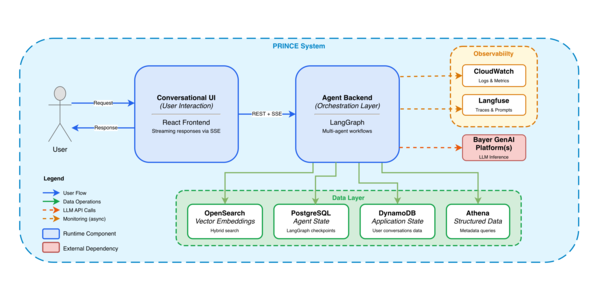
Writing on martinfowler.com, Sarang Kulkarni — a Principal Consultant at Thoughtworks — walks through PRINCE, a Bayer preclinical-research assistant that evolved from keyword search into a conversational, agentic system.
How PRINCE answers a research question
The pipeline is a LangGraph-orchestrated chain of specialists. A request flows Clarify Intent → Think & Plan → a Researcher that runs a hybrid retriever, combining RAG over PDFs in OpenSearch with Text-to-SQL over structured metadata in Athena. A Reflection agent then checks whether the retrieved data is sufficient, and only afterward a Writer agent synthesizes a cited answer.
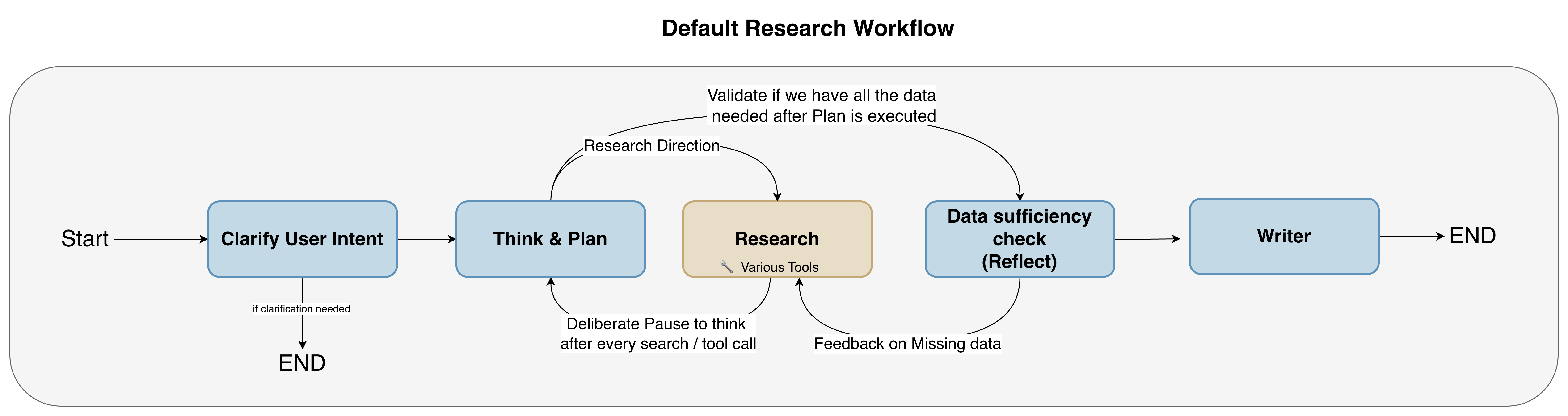
Kulkarni rests reliability on two pillars. Context engineering means each agent sees only what it needs, keeping prompts narrow. Harness engineering means the operational scaffolding: PostgreSQL state through the LangGraph checkpointer, automatic retries, fallback LLM providers, and graceful recovery when a step fails. The article names evaluation frameworks (RAGAS, faithfulness, answer-relevancy) but reports no accuracy or latency numbers of its own.
The thread wants the ablation, and the metric
The first objection is that the elaborate decomposition is never justified against a simpler baseline. One coder put it bluntly: "an agent is just a system prompt and output contracts, and these rich architectures seem to be pontificating beyond their worth. It all feels a bit vibe-y."
"an agent is just a system prompt and output contracts, and these rich architectures seem to be pontificating beyond their worth. It all feels a bit vibe-y." — James, a coder
Then a reader went to the linked Frontiers paper and pulled out the number the post never prints:
"the overall capability of the chatbot to fully meet user needs received a lower average score (3.1/5.0)… This is a system for scientific research on medicines and mediocrity and hallucinations will kill people." — a commenter citing the source paper's own figure
An engineer who has shipped this kind of system argued the architecture is the easy 1%, and the data is the other 99:
"I pitched a custom enterprise agent… thinking it'd be 50/50 time on data vs agent tuning, but it's more like 99/1." — an engineer who built a custom enterprise agent
And the proportion of the piece itself drew fire:
"Two paragraph section on Evaluation after 30 paragraphs explaining the most bog standard rag system you've ever heard of." — a reader weighing how much to trust the writeup
Architecture is legible; outcomes are not
The gap is the story. A diagram of agents is easy to admire and hard to falsify, while a 3.1/5.0 on meeting user needs is the kind of fact that decides whether any of it should ship into drug research. The thread keeps circling one reason the article feels thin: it documents the machine in exhaustive detail and the results in two paragraphs — when, for a medical tool, the results are the only thing that matters.
Get breakdowns like this every day
The top Hacker News stories, unpacked — by email, Telegram, or RSS.
The brain was not built for this much bad news before lunch
A war in one region, a financial shock in another, a climate disaster in a third — all before noon. The threat-weighting circuit that once kept you alive now fires at events you will never touch.