A St Andrews lecturer says one array bug sinks Microsoft's qubit
Henry Legg traced Microsoft's topological-qubit claim to two lines of Python: a hardcoded plot filter hiding a second data region, and an antisymmetrization that reverses an array index instead of reading physical voltage. Fix them and the result disappears.
Microsoft's code computed bias-axis symmetry with x[::-1], reversing array positions rather than the actual measured values. A separate filter, zbp_cluster_numbers=[1], plotted only the largest region; setting it to [1,2] surfaced data the paper omitted.
Legg's critique was accepted by Nature on April 20, 2026. Microsoft's Chetan Nayak calls the issues minor; the thread surfaced a 2016 Nature retraction caused by an equally small sign error.
A Nature paper undone by an array reversal
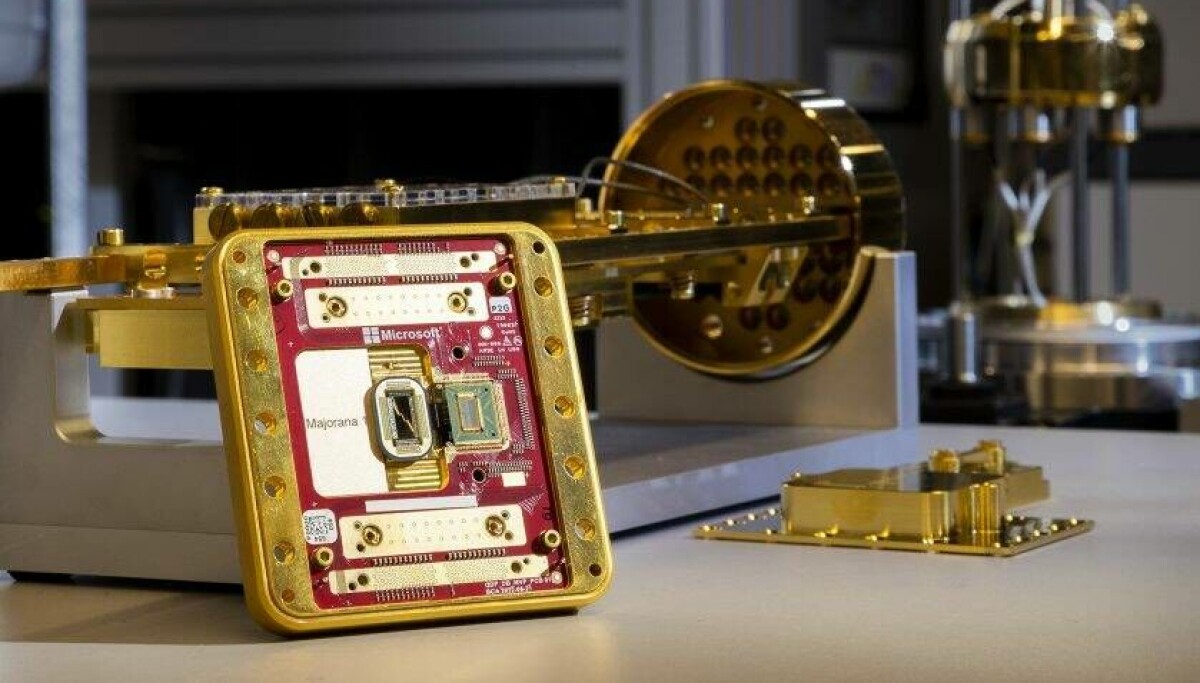
Dr. Henry Legg, a lecturer at the University of St Andrews, says Microsoft's evidence for a topological qubit collapses under two ordinary programming mistakes. The Register lays out both. First, the plotting code hardcoded zbp_cluster_numbers=[1], showing only the largest region of the data; changing it to [1,2] revealed a second region the published figure left out. Second, the antisymmetrization step — meant to test how a signal behaves under a flipped physical bias voltage — used a plain x[::-1] array reversal, operating on index order rather than the actual voltage values it claimed to compare.
Legg's paper, "On the robustness of topological gap detection via transport," was accepted by Nature on April 20, 2026 and published June 24. His conclusion: with the bugs fixed, the devices show "considerable disorder" and miss the prerequisites for the topological-gap claim Microsoft announced in February 2025, when it said a meaningful quantum computer was years rather than decades away. Legg's revised estimate is "centuries." Microsoft's Dr. Chetan Nayak called the issues "minor," arguing that "success is the delivery of a scalable quantum computer."
The thread debugs the debugger
Readers did not take the bug on faith; one opened the source and reproduced the reasoning in the thread:
"they seem to have used memory offsets as if they were physical coordinates… x[::-1] isn't measuring physical coordinates; it's just reversing the array." — a programmer who traced the asymmetry computation
Others measured the gap between Microsoft's response and the specificity of the finding. One was struck the outlet nailed the detail:
"Legg showed that fixing the bug invalidates the research. Seems Microsoft is responding to a clear problem with a vague dismissal." — a reader on the rebuttal
A researcher with prior respect for the lab registered disappointment:
"You'd really think they'd really check everything… I generally have a very high opinion of MS research, but this is getting a bit embarrassing." — a commenter on Microsoft's track record in Majorana QC
And one supplied the precedent that makes this less of a one-off:
"Not the first time that a Nature publication's 'too good to be true' results turn out to be based on simple programming errors… Nature 532, 210 (2016) was retracted after… a simple sign error." — a reader citing a prior retraction
The uncomfortable throughline: the most consequential physics claim of the year may hinge less on Majorana fermions than on whether anyone code-reviewed the figure script.
Get breakdowns like this every day
The top Hacker News stories, unpacked — by email, Telegram, or RSS.
A 16,000-line Rust parser written by Claude that the author never read
PostHog's Robbie Coomber replaced a C++ ANTLR SQL parser with 16,000 lines of Rust he says he never wrote by hand. The trick: the old parser became an oracle, and a fuzzer fed Claude failing cases until the two agreed on millions of queries.