A fake DMCA from an island with zero inhabitants erased his article from Google
Gergely Orosz's 2022 investigation into a collapsed festival startup vanished from Google search. The takedown claimed his post plagiarized a 1998 New York Post piece called 'Band Leader Hits Winning Chord' — two texts that share not a single sentence.
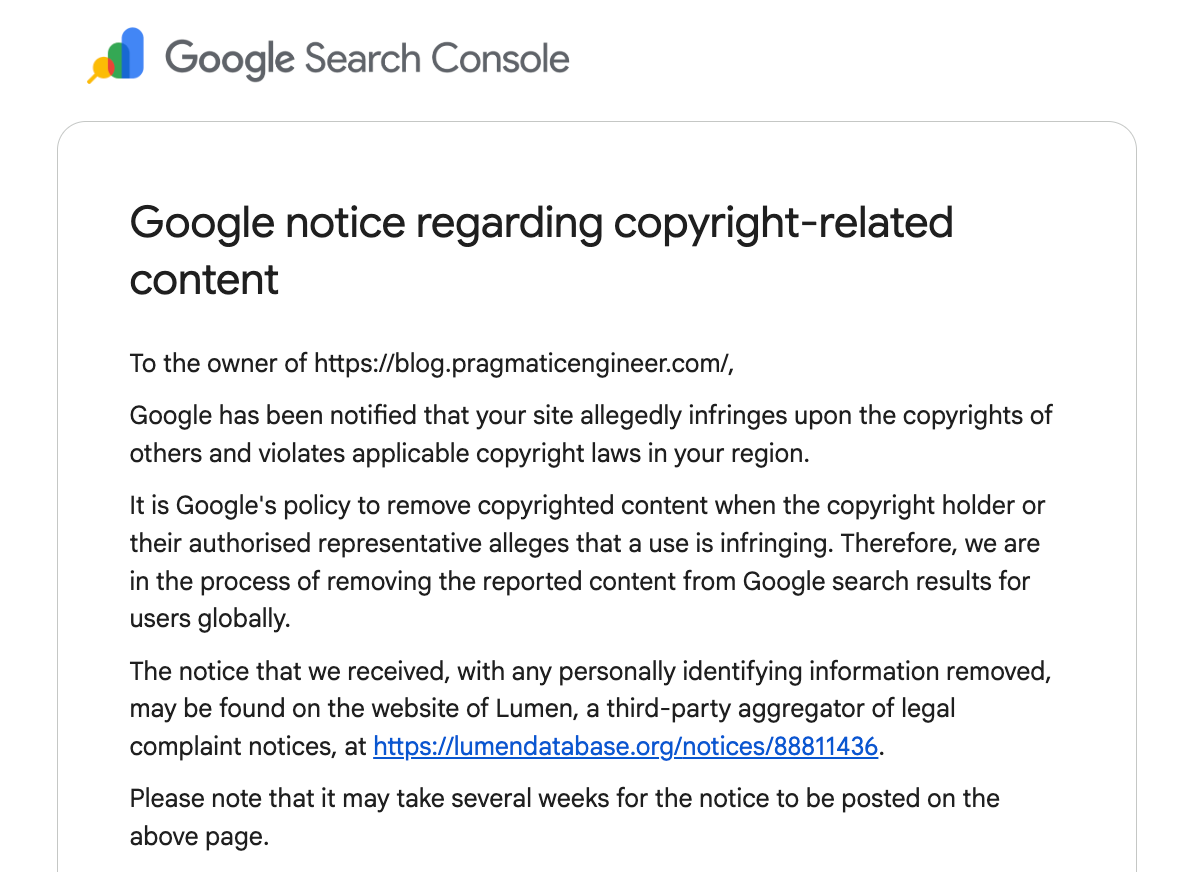
The complaint was filed by an 'Ellie Piee' located on Bouvet Island, an uninhabited Norwegian territory near Antarctica with a population of zero. The asserted source it 'copied from' had nothing in common with the original. Google delisted the article anyway.
Someone who runs a domain-court case search engine recognized the pattern instantly: he gets the same bogus copyright purges aimed at publicly documented arbitration records. The cost to file is nothing; the cost to fight it falls entirely on the writer.
A delisting request filed from a place where nobody lives
Gergely Orosz, ex-Uber and Microsoft engineer and author of The Software Engineer's Guidebook and the Pragmatic Engineer newsletter, wrote in 2022 about the implosion of the festival-ticketing startup Pollen. The piece documented a company that announced $150M in funding in April 2022, then laid off about 200 people (a third of staff) three weeks later, left wages and pension contributions unpaid, and filed for bankruptcy on August 10, 2022. A BBC documentary, Crashed: $800M Festival Fail, covered a $3.2M double-charge of customers that Orosz says was manually initiated by the CTO.
Four years later the article quietly dropped out of Google's search index. The reason: a copyright complaint asserting Orosz's post had plagiarized Band Leader Hits Winning Chord, a 1998 New York Post article. The two texts, he notes, share not a single sentence. The complainant called herself "Ellie Piee" and filed from Bouvet Island, an uninhabited Norwegian dependency in the South Atlantic with zero inhabitants. Orosz is, as he puts it, the only possible copyright owner of his own writing. Google complied with the removal anyway.
The thread: this is an industry, and the math rewards it
The sharpest confirmation came from someone who runs into the same purges professionally:
"I help run a domain legal case search engine (UDRP.tools) and we run into this type of stuff too. Notices that results are being purged… These aren't private and it's not personal information. It's all coming from publicly documented arbitration decisions." — the operator of a domain-court case search engine
A reputation-management trade exists to do exactly this, and several engineers traced the abuse to one root cause: incentives. Filing a fraudulent notice is free and carries no liability, while contesting one costs the victim hours or money.
"Submitting a bogus DMCA is basically free. Google's cheapest option is to comply first and sort it out later. Meanwhile the person who did nothing wrong has to spend hours (or money) fixing it. That's a system where every incentive points toward abuse." — a developer-tools founder
The legal-mechanics reading went a step further: even a real, signed notice rarely produces consequences.
"DMCA notices are meant to be submitted 'under penalty of perjury'… In practice, neither of these occur even if the sender is a real person… Requiring verification through government ID for takedown notices should be a minimum requirement." — a commenter walking through the perjury clause
A security researcher offered the most cynical theory — that the obvious fakeness is a feature, not a slip:
"I'm guessing the obvious fakeness of the request is part of it: they're testing to see if anyone is paying attention… It also costs them nothing and has zero legal liability because there's nobody to prosecute for such a fake request." — nneonneo, an HCI and security researcher
The ending writes itself, and the thread named it: the takedown attempt turned the engineer's old post and this HN discussion into the top Google results for the CEO's name. A fraudulent notice with no human behind it cost nothing to send, and bought the opposite of silence.
Get breakdowns like this every day
The top Hacker News stories, unpacked — by email, Telegram, or RSS.
Apollo says the Mag 7 is cracking. The thread says: one month proves nothing
Torsten Slok's 32-slide deck argues the seven mega-caps are losing their lead as money rotates to free cash flow. HN's investors and engineers spent the thread arguing he drew a trend line through a single quarter.