Why 24-bit/192kHz audio makes no sense — and the three practitioners who complicate it
Xiph's Monty Montgomery has argued since 2012 that hi-res music downloads are pointless for listening: 44.1kHz already captures everything you can hear, and 192kHz can actively make playback worse. The thread mostly agreed — then carved out the exceptions.
The physics is unforgiving: ears top out near 20kHz, so 44.1kHz captures all of it, and ultrasonic content can fold distortion back into the audible band. A Boston Audio Society test nailed it — 554 trials, listeners correct 49.8% of the time. A coin flip.
But the practitioners drew real lines. A music producer swears he hears 16-bit vs 24-bit in his own renders. A film sound designer records to 100kHz because slowing that audio reveals real content above hearing. A DSP researcher prefers high rates for more forgiving filters — all while agreeing about final playback.
The 2012 argument that keeps being right

Monty Montgomery of Xiph.org argues that 24-bit/192kHz music makes no sense as a consumer format. The audible range is roughly 20Hz–20kHz, so by Nyquist a 44.1kHz sample rate captures all audible content perfectly; 192kHz mostly wastes storage and can degrade playback, because ultrasonic content drives intermodulation distortion in amps and speakers that folds back down into what you can hear.
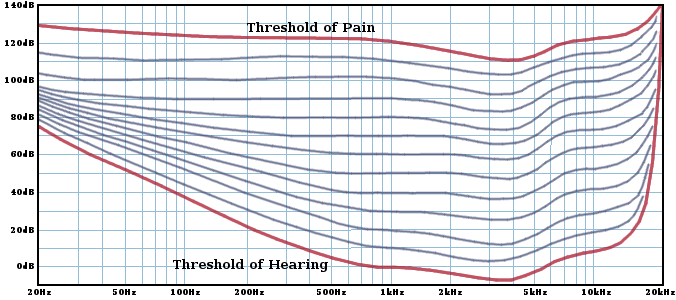
On bit depth, 16-bit already gives ~96dB nominal (and ~120dB effective with proper dither, given how the ear masks noise per frequency band), beyond any real listening need. The clincher is a Boston Audio Society ABX test: across 554 trials, listeners chose correctly 49.8% of the time — chance. High resolution is genuinely useful in the studio (headroom, cleaner processing), just not in the finished download.
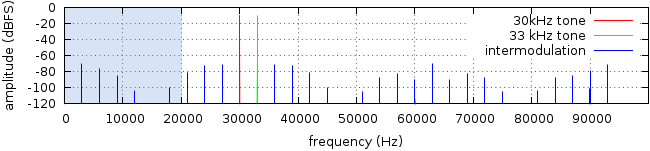
There's a companion demo that walks through the digital-audio myths in person:
.The practitioners who complicate the verdict
Nobody serious disputed the sampling-rate math — but bit depth got a firsthand challenge:
"the article claims that the final distribution doesn't need to have a bit depth of more than 16. That does not match my experience. I can tell the difference between my renders that are 16 bit vs 24 bit. I cannot tell the difference between 44.1 kHz and higher sample rates, and that's consistent with the math." — a working music producer
A film sound designer explained where the "useless" ultrasonics become the whole point:
"I use microphones that can 'hear' up to 100kHz (Sanken CUX100K) and for film sound design playing 192kHz audio at half and quarter speed the results are very significant, and reveal there IS 'content' above human hearing. Irrelevant for general listening but very important for sound design." — a pro audio engineer and film sound designer
And a DSP researcher defended high rates for processing, not listening — the filters are "much more forgiving and less lossy at 192kHz." The synthesis the thread lands on is cleaner than the format war it replaces: for the thing in your ears, 16/44.1 is already transparent, and a reader's own blind ABX couldn't beat it. For the thing on the engineer's timeline — capturing, slowing, filtering — the extra bits and hertz do real work. The mistake was ever selling the studio's tools as the listener's upgrade.
Get breakdowns like this every day
The top Hacker News stories, unpacked — by email, Telegram, or RSS.
An offer to press your GitHub repo onto a CD-ROM, and the reason it looks like phishing
A form appeared offering to burn your public repo to a physical CD and mail it to you — first 1,000 submissions, valid July 2–6. It reads as Microsoft ribbing Sony for killing physical media. It also reads, to a lot of engineers, like a scam.