Auto-download daily
Issue · July 3, 2026

Top of Hacker News

26 stories of the day: AI, technology, business and simply interesting discussions — recapped and unpacked.

Spain moves to blacklist Palantir — while its own generals lobby to keep it (clashreport.com)

Spain is directing its state-controlled companies — Telefónica, Indra, Navantia and firms under the SEPI holding — to drop the US data-analytics firm Palantir, citing the risk of misuse of classified national-security information.

The thread refused the clean sovereignty story. One reading: Palantir is being pushed out precisely because it is better, and Europe is dodging an uncomfortable capability gap. Another: the concern was never security but who is paying — so why not just let Spain's own Indra do the work?

Not just a headline — the discussion unpacked

The top HN threads: facts from the discussions, both sides, insider voices. Email, Telegram, or RSS.

A reader asked a blogger to sound less British. His one-word answer started 400 comments (shkspr.mobi)

The refusal wasn't the story; the argument under it was. Eden's point: a language tag isn't a wall, it's a signature — the culture he lives in, the way he thinks, the accent he writes in — and encountering something unfamiliar is a feature, not a bug.

Then the thread did the thing the post was about. A developer had actually built the Accept-Language easter egg the piece only gestured at, serving Brits a different site entirely. And when a commenter fretted for Eden's 'safety,' the author himself dropped in to reply, in full character: 'OP here. Fuck off.'

Virginia just banned selling your location data — with a loophole you could drive a Flock truck through (hunton.com)

The ban amends Virginia's Consumer Data Protection Act and took effect this week, joining Maryland and Oregon. It targets a real harm: location feeds have already been used to track visitors to hundreds of Planned Parenthood clinics for an anti-abortion ad campaign.

The thread's privacy lawyers zeroed in on the wording. Maryland and Oregon ban exchanges for 'monetary or other valuable consideration'; Virginia only says 'monetary.' That one missing clause is exactly the gap the license-plate-camera firms already live in — sell the cameras, hand over the dashboard 'for free.'

PeerTube can serve a video to thousands without a big server. The thread explained why that still isn't YouTube (github.com)

It's a free, federated video platform from the French nonprofit Framasoft: no ads, ActivityPub federation with the Fediverse, and peer-to-peer playout so simultaneous viewers offload bandwidth from the host.

A working YouTuber did the money math and it was brutal — a ~100K-subscriber channel that couldn't survive on under $500–$1,000 a video, which PeerTube has no way to provide. As one authority put it: the tech does exactly one of the four jobs a YouTube replacement needs, and it does that one fine.

A maintainer spent 100 hours keeping AI code out of his project — and may lose modern Git to do it (joeyh.name)

He didn't reach the rule on principle first. Auditing dependencies, he found large LLM-generated changes reverted with no explanation, incoherent commit messages, and questionable code-copying — then spent ~100 hours drawing a clean line around his supply chain.

The thread split hard. Some users said the practical price — abandoning the world's dominant version-control tool over a disclosure tag — is one they won't pay. A ZeroTier founder went after the premise itself: reliable AI-code detection, he argued, is 'today's polygraph test pseudoscience.'

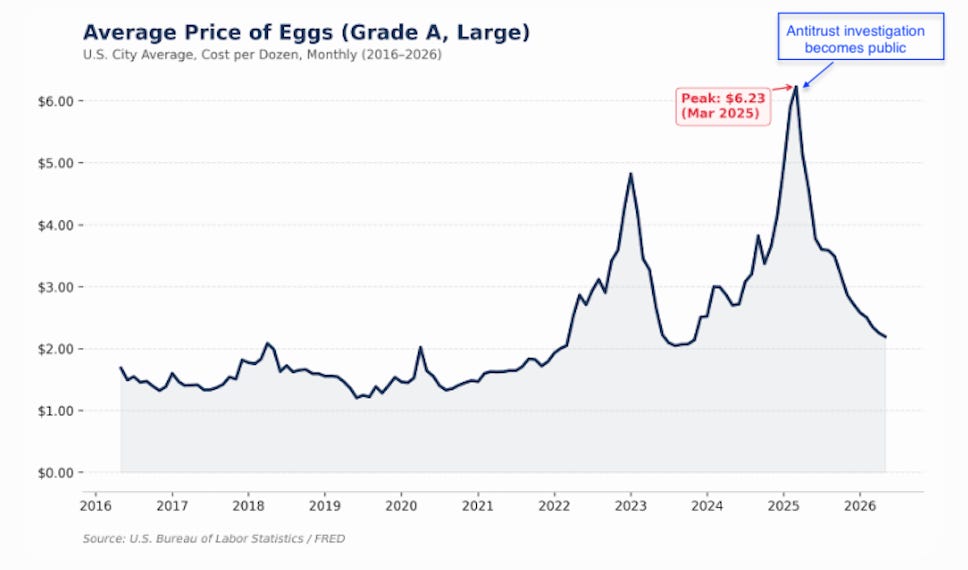
The egg cartel paid a $3 million fine. Investigators say the price-fixing made a thousand times that (thebignewsletter.com)

The producers — Cal-Maine, Versova, Hickman's — agreed to pay roughly $3 million total and donate 53 million eggs to food banks, with no admission that changes the math Matt Stoller put in his headline: the fine is a rounding error against the profits.

The sharpest thread voice wasn't the outrage; it was the correction. It can be both, one reader argued — a genuine hen-culling shock AND collusion riding on top of it. And a commenter who'd spent years citing the egg saga as proof greed doesn't set prices publicly ate his words.

The US government quietly became a shareholder in 26 companies. Someone added it all up (moeonmargin.substack.com)

The move that recurs isn't a stock purchase — it's the off-take deal, where Washington becomes co-owner, co-funder and guaranteed customer at once. The MP Materials template: a stake plus a 10-year rare-earth price floor plus a promise to buy the output.

HN reached for every ideology at once — socialism, fascist corporatism, state capitalism. The most grounded voice wasn't reaching: a former Obama/Biden-adjacent policy hand, now a VC, called it bipartisan industrial policy with a long lineage, not an aberration.

OpenAI floated giving Washington a 5% stake — worth about $43 billion. The thread called it a moat, not a gift (theguardian.com)

Altman's pitch: it shares AI's upside with the public, modeled on Alaska's oil fund. The reported terms include an ask for Anthropic, Google and Meta to match, with talks running through Trump, Lutnick and Bessent.

HN read it as strategy, not generosity. If the government owns a slice of OpenAI, how does it regulate OpenAI — or bless a rival's merger? One founder called it a Trojan horse for 'too big to fail' status. Another asked: if the public shares the upside, why 5% and not 50%?

Google lost its last appeal on a $4.7B EU fine. The thread argued whether the fine ever mattered (cnbc.com)

The fine punishes deals that forced Google's apps onto Android phones via pre-installation. The US ambassador to the EU warned Europe against over-regulating its way out of the AI economy.

HN's real fight was whether antitrust even fits Google. One argument: it was built for manufacturers with prices and marginal costs, and Google has neither. A European reader called that a distinctly American way to miss the point — here, antitrust was never mainly about price.

Labor-force participation hit a 50-year low. The same number told two completely opposite stories (cnbc.com)

The figure everyone quoted: prime-age participation, workers 25–54, fell 0.6 points to 83.3%, lowest since December 2023. One reader used that official number to demolish the 'all fine, just retirements' take — that cohort is nowhere near retiring.

The insiders made it concrete. A tech executive said the 'early retirement' his ex-colleagues took was involuntary age discrimination. Another described the mechanism breaking hiring: HR drowning in thousands of AI-slop applications a week, until word of mouth is the only channel left.

📈Biz ★ 153 · 💬 133 · Jul 3 · #AI#economy#Bureau of Labor Statistics#CNBC

A mathematician who quit academia says AI will kill the 'theorem economy' — and maybe save math (davidbessis.substack.com)

His distinction is Mathlib versus Mathslop: human-curated formal math you can understand, versus AI output that's correct and unreadable — a 200,000-line proof no one comprehends. If status flows only to proving, and machines prove best, mathematicians become obsolete.

The thread pushed back from two sides. A non-mathematician shrugged: if unreadable-but-correct theorems let us build useful things, who cares? Another reached for Greg Egan's 'truth mining' — and the one edge humans keep, for now: today's models are still weak at visual reasoning.

How to ask a stranger for help — and why 100 handwritten notes got zero replies (pradyuprasad.com)

His five moves: prove your work (credentials are the weakest signal), give only the context that matters to them, make saying yes cheap and specific, make saying no easy, and never deceive. Genuine help, he argues, should feel effortless — like holding a door.

The thread's best counter came from someone who ran the experiment. First attempt: 100 painstaking handwritten notes, not a single reply. Second: a few-sentence email with one clear ask — a 15% response rate and real conversations. Less work, more help. Someone on the receiving end of ten requests a week explained why.

🌍Other ★ 419 · 💬 164 · Jul 3 · #culture#Pradyu Prasad

Scott Aaronson and Cynthia Dwork warn: a new order tells the Census to protect privacy like it's 1975 (scottaaronson.blog)

Their demonstration is a brewery: five aggregated statistics about beer-related businesses form a solvable system of equations that recovers individual firms' employee counts, even after careful rounding. Coarsening, they argue, loses usefulness AND fails at privacy — the worst of both.

The thread added context and doubt. A Stanford CS voice noted 2020 was the first census to use differential privacy, that lawsuits question its constitutionality, and that citizenship status could be inferred by cross-referencing products. A practitioner just sighed that an interesting technology had gone political.

'You can't find bugs by reading code.' A one-line post about code review split the experts (mathstodon.xyz)

The provocation was doing a lot of work as written, so the author stepped into the thread to narrow it: as a mathematician, he means you can't find all bugs or any particular bug — not that finding bugs never happens.

A WebAssembly co-founder wasn't buying the softened version either, calling the thesis 'self-justification for being a lazy code reviewer.' And a 90k-karma veteran landed the real finding: there is no 'the' purpose — we all thought we were reviewing for the same reasons, and we simply aren't.

GitHub put a Chinese open model in Copilot. The thread was too busy leaving over the price hike to notice (github.blog)

The launch itself is clean: Kimi K2.7 is selectable across VS Code, JetBrains, Xcode and the rest, hosted on Azure, billed usage-based. At Moonshot's rates, one reader clocked it at roughly GPT-5.4-mini territory.

Then the real conversation took over. A Copilot CLI superfan described his whole department burning the monthly budget every two to three days after June and defecting to Claude Code, guessing Copilot 'lost 50% or more of their customer base last month.' A small team hit an undocumented 10-license minimum and left for Cursor.

Cursor's benchmark says its cheap model rivals the frontier. A rival benchmark says it scores 16 (cursor.com)

On Cursor's numbers, Composer 2.5 hits 63.2% accuracy at $0.55 a task — the cheapest in the field, and framed as near-frontier. The presentation even flipped the cost axis so cheapest sits on the right, which several readers found conveniently confusing.

The rebuttal came with citations. On the DeepSWE benchmark — 'probably the hardest to game' — GPT-5.5 gets 64, Opus 4.8 gets 56, and Composer 2.5 gets 16. A developer who's used both models heavily called the parity claim 'absolutely farcical': faster, yes; anywhere near as good, no.

Podman 6.0 rebuilt its networking stack. The thread was really about whether it can replace Compose (blog.podman.io)

The pro-Podman case in the thread was security and ergonomics: no 'container root equals host root' games, no daemon, no holes punched in your firewall. One CTO switched after Docker Desktop ballooned in memory — 'literally as easy as installing it and pointing it at our docker-compose.yml.'

The honest counterweight was portability. Podman's file-per-unit Quadlet model can't match Compose's single, readable, shareable file for team development — and getting current versions on Ubuntu without stale distro repos still, one reader argued, keeps losing Podman to Docker.

Vite+ wants to be the one toolchain for the whole web — and manage your Node runtime too (voidzero.dev)

Vite+ unifies Vite 8, Vitest, Rolldown, tsdown, Oxlint and Oxfmt plus a cached monorepo task runner, MIT-licensed. A power user already running the full stack in production reports it 'just works.'

The skeptics circled two things: why a build tool should manage your Node runtime at all ('extraordinarily opinionated'), and whether another layer over Vite's five-majors-in-four-years churn is worth it. The '+' also set off a reflex fear of monetization — though the Cloudflare acquisition may have taken that motive off the table.

Immich 3.0 adds non-destructive editing — the thread argued about the feature it still doesn't have (github.com)

Version 3.0 is a real step: non-destructive crop/rotate/adjust on mobile, a Workflows automation engine, HLS on-the-fly transcoding, and integrity checks that catch missing or mismatched files. Breaking changes hit third-party integrations.

Encryption was the fault line. Several users said the lack of E2EE is why they picked Ente instead. A contrarian pushed back hard: for a home photo library, end-to-end encryption is arguably pointless — lose your keys and you lose the only copy of grandma. The sharpest bug report was an operator finding 20% of his disk eaten by duplicated per-user thumbnails.

Japan's top court says an AI can't be a patent inventor. The thread says that's not the story (japannews.yomiuri.co.jp)

Japan joins the US Federal Circuit and courts worldwide: only a human can be a legal inventor. The plaintiff is Stephen Thaler, who has made a career of filing DABUS applications around the globe and has reportedly won exactly once, in South Africa, where patents are barely examined.

The thread's correction is that this decides far less than the headline implies. The ruling doesn't touch AI-assisted invention — a human can still patent work done with an AI's help. The court only refused to name the machine itself. As one commenter shrugged: the fix is to put your own name on it, which is exactly what the ruling permits.

For two years, a Linux change left disk-encryption keys sitting in RAM through suspend (mathstodon.xyz)

The mechanism at issue is cryptsetup's luksSuspend, which is supposed to scrub the master key from memory before sleep. The claim: it quietly stopped, leaving the key resident and, in the post's words, 'for the taking by anyone who seized the still-powered laptop.'

The thread's corrections matter as much as the bug. Several readers noted luksSuspend is a Debian extension, so the headline overstates a kernel-wide flaw. Others questioned the threat model — a locked laptop isn't trivially readable by 'anyone' — and the most practical fix offered was to hibernate: power the RAM off and the whole class of cold-boot attack goes away.

🚀Tech ★ 415 · 💬 190 · Jul 3 · #open source#privacy#security#Debian#Linux#LUKS+1

Someone translated the entire Rust compiler into 46 million lines of C (github.com)

The goal isn't the 46M-line artifact; it's the tool that produced it. The author's 'cilly' compiler probes the target C compiler with tiny witness programs instead of assuming anything beyond ANSI C, and can even compile over the network — so 'unsupported target' stops being a knock against Rust.

The thread found the genuinely useful uses. An ex-compiler developer gave a flat endorsement. Others pointed to easier Rust bootstrapping and a security trick: use crustc for Diverse Double-Compiling to check whether the official rustc has a backdoor. The skeptic's fair point: who trusts a beta transpiler on an exotic target?

An AI-generated news site invented a reporter to mourn the death of real news (niemanlab.org)

Nieman Lab documented theeditorial.news, an apparently AI-run operation churning out fake coverage of rural American papers — vivid, human, entirely invented — that framed AI slop as the death of real news. By the time it circulated, the site had gone 'Under Construction.'

The thread's SEO people saw a business, not a prank: wire an autoblogger to Search Console, keep whatever ranks, and you get a self-reinforcing slop machine at cents per article. A dissenting voice cut deeper: real local news was killed by venture capital a decade ago — AI is just filling the vacuum.

Why 24-bit/192kHz audio makes no sense — and the three practitioners who complicate it (people.xiph.org)

The physics is unforgiving: ears top out near 20kHz, so 44.1kHz captures all of it, and ultrasonic content can fold distortion back into the audible band. A Boston Audio Society test nailed it — 554 trials, listeners correct 49.8% of the time. A coin flip.

But the practitioners drew real lines. A music producer swears he hears 16-bit vs 24-bit in his own renders. A film sound designer records to 100kHz because slowing that audio reveals real content above hearing. A DSP researcher prefers high rates for more forgiving filters — all while agreeing about final playback.

An offer to press your GitHub repo onto a CD-ROM, and the reason it looks like phishing (forms.cloud.microsoft)

The joke lands because Sony just announced PlayStation is dropping physical media, and here's GitHub offering to put your code on a disc. Nice bit — except the 'GitHub' offer is a generic Microsoft Forms page anyone could have made, which is exactly what phishing looks like.

The thread couldn't decide if it was official, and enjoyed it anyway. One caught the archival irony: these would be burned discs, good for ~10 years, versus GitHub's real Arctic Code Vault. Another caught the copyright one: it asks permission to press your public repo to a CD — but training AI on all of it didn't need a checkbox.

A 2018 hacking puzzle game where you learn to code by reading a magazine like it's 1997 (zachtronics.com)

Zachtronics' EXAPUNKS makes you write stripped-down assembly to infiltrate systems, taught through TRASH WORLD NEWS, a fictional hacker zine printed inside the game. Commenters credit it with curing their fear of low-level code.

The nostalgia came with a news hook: Zachtronics stopped making games, but Zach Barth is back under a new studio, Coincidence Games, with a spacecraft-engineering puzzler already out. And the design lesson players keep relearning: solve first, optimize second — pre-optimizing is futile.