Webb keeps finding black holes too big, too early to exist
A billion-solar-mass black hole sits 650 million years after the Big Bang, feeding at 40 times the speed limit physics allows. Webb keeps finding more like it.
Webb has photographed a billion-solar-mass black hole just 650 million years after the Big Bang, feeding at 40 times the limit physics allows, plus hundreds of enigmatic 'little red dots.'
The problem isn't too little data but too many theories. ZeroTier's founder is betting on primordial black holes; another reader dug up the paper testing whether the red dots are just brown dwarfs.
Webb keeps photographing things that shouldn't be there
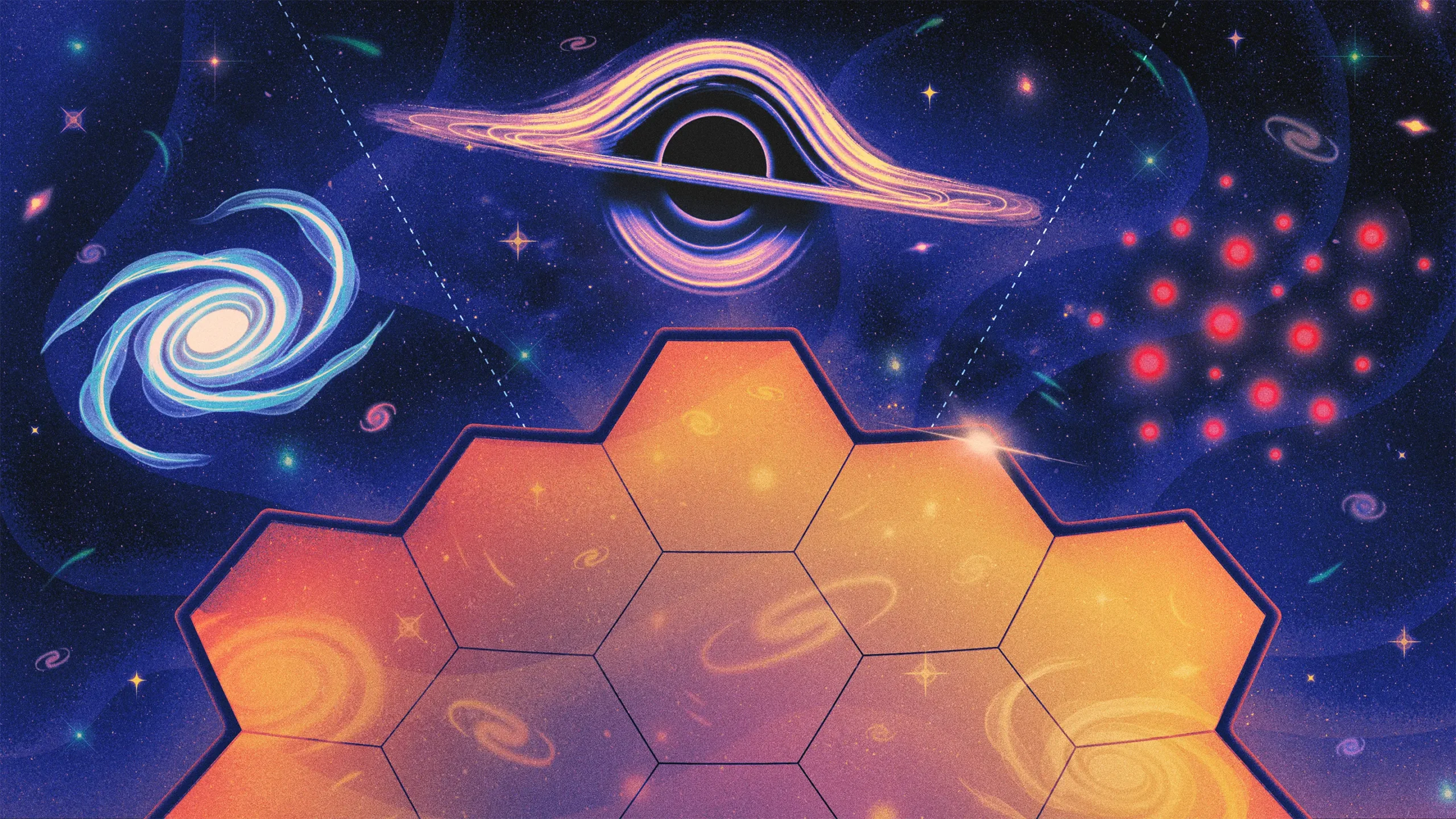
The James Webb Space Telescope has found billion-solar-mass black holes sitting just 650 million years after the Big Bang, far too heavy to have grown the ordinary way. "you have to do some gymnastics," Princeton astronomer Jenny Greene told Quanta, to explain black holes that appear to feed at 40 times the Eddington limit meant to cap how fast they swallow gas. Three origin stories compete: stellar-collapse seeds that merge fast, direct collapse of giant gas clouds under "Goldilocks" conditions, or primordial seeds that existed as naked supermassive black holes before any galaxy formed.
The galaxies are no calmer. Some shining just 280 million years after the Big Bang look brighter than the models allow, and theorists are drowning in fixes rather than starved of them. "We almost have gone from having too many" explanations, cosmologist Rachel Somerville said.
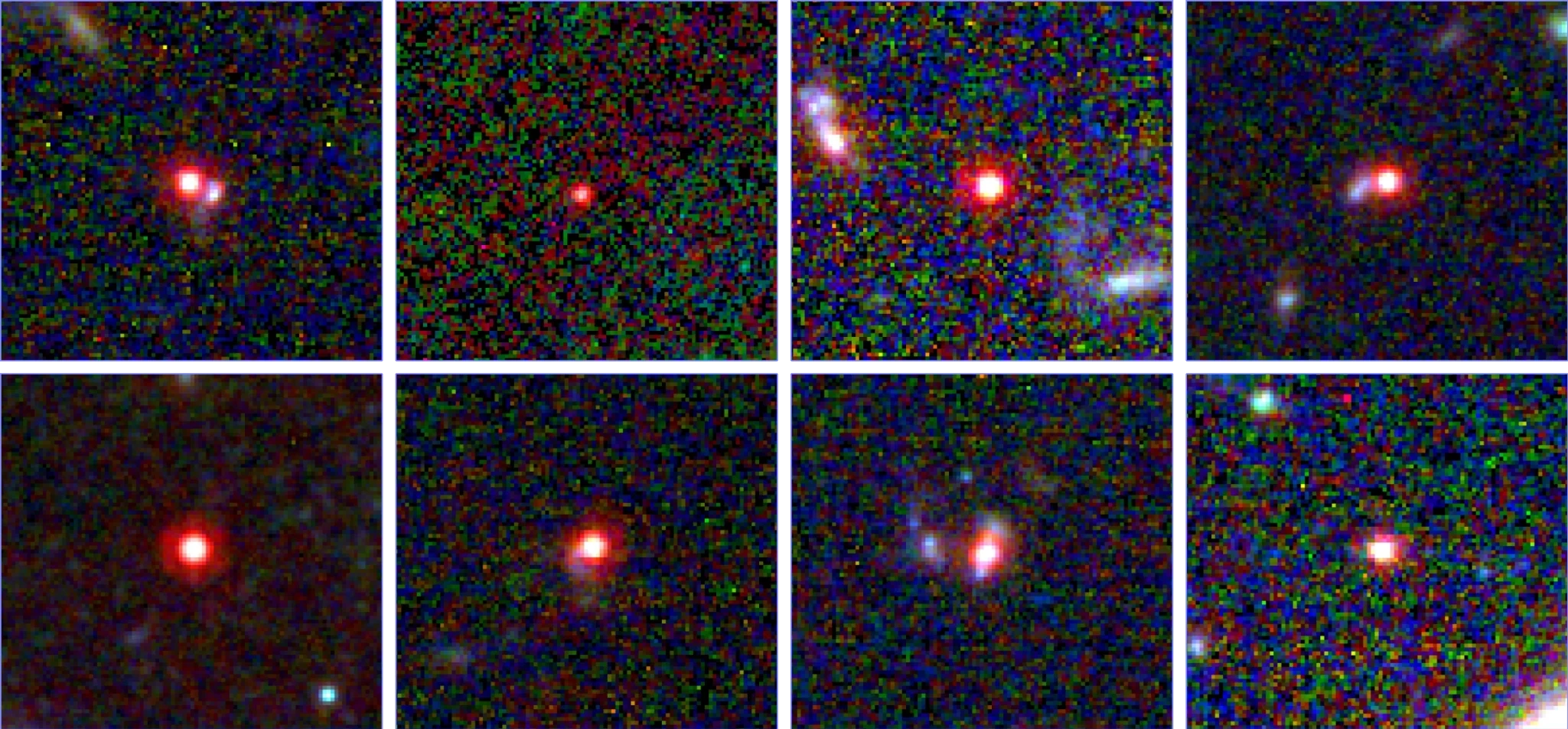
Then there are the little red dots, hundreds of them around 650 million years after the Big Bang. The leading guess is a black hole wrapped so tightly in gas that the shroud glows like a stellar atmosphere, a hypothetical object dubbed a "black hole star." Spectroscopy keeps poking holes in the picture.
The thread's own theories, and a shot at the messenger
The founder of a networking company made the case for the most radical read of the data:
"JWST has provided the first good indirect evidence [for primordial black holes] in the form of too-early galaxies… They are a dark matter candidate, and one that doesn't require new physics." — the founder of ZeroTier
He went further in the thread: such objects could be captured in our own solar system, an asteroid's mass packed into the size of a hydrogen atom, invisible except by its gravity.
A more deflationary note asked whether the red dots are even extragalactic, then answered itself:
"many of these little red dots are turning out to be nothing more than bog-standard brown dwarfs in our own galaxy… It turns out that brown dwarfs are actually corrected for." — a reader who chased down the paper
The arXiv preprint he cited rules that contamination out. Two other readers aimed at the framing rather than the physics. One rejected the subtitle's promise of finding "which ones are true":
"Science isn't about finding out what is true. Science is about finding out what is false and building models to explain the rest." — one reader on the subtitle
Another distrusted the outlet itself:
"Quanta magazine is a glorified university press release and marketing shop for Simons associated institutions." — a skeptic of the publisher
The through-line is not a crisis of data but a glut of explanations. Webb handed cosmology more plausible theories than it can currently kill.
Get breakdowns like this every day
The top Hacker News stories, unpacked — by email, Telegram, or RSS.
GPT-5.5 Codex keeps stopping at exactly 516 reasoning tokens and getting it wrong
Give GPT-5.5 Codex a puzzle and sometimes it thinks for exactly 516 tokens, then hands back the wrong answer. An OpenAI Codex issue shows those stops aren't random: they pile up at fixed thresholds 518 tokens apart, and they track failures.