One essay's fix for AI chaos is giving every worker their own agent
Gavriel Cohen's proof that AI agents are already outpacing human oversight: an engineer who ran dozens of them in parallel and rewrote a legacy codebase in under two weeks. He argues that power needs a name and a face behind it, not a handful of AI labs deciding who gets to use it.
An engineer used 64 Claude Code instances in parallel to rewrite 535,496 lines of Zig into Rust in 11 days, about 750 engineer-days of work. Gavriel Cohen calls it proof AI agents need a human directly accountable for what they ship, not a handful of AI labs deciding for everyone.
On Hacker News, a SaaS founder said the alarm over ungoverned agents smelled like the "shadow IT" scares vendors sell before pitching a governance platform, while a survey the essay cites found 52% of workers already run unapproved AI tools anyway.
A fix for "who manages the agents": give every worker one to own
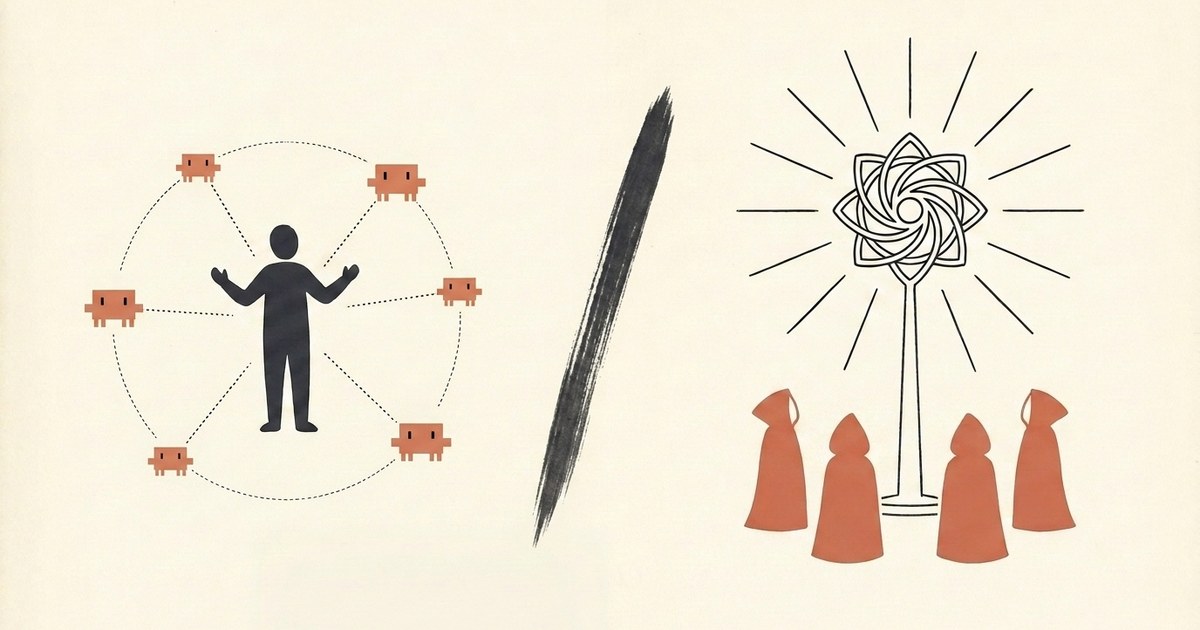
Gavriel Cohen, writing on off-policy.com, frames the AI industry as approaching a fork. On one path, he warns, "a tiny group mediates between machine intelligence and everyone else," deciding which capabilities the rest of the world gets to use; as that group's own systems get smarter than they are, he writes, "it becomes less clear who is directing whom." On the other path, capable agents are distributed to billions of people, each pointed at their own goals instead of routed through a handful of labs.
Cohen's fix sits on the second path. Give every person on a team their own agent: "owned by your company and issued to them, that they manage and that helps them do their work," progressing from personal use to team channels to public-facing roles as the person running it gets better at the job. The human, in his framing, stays at the center: "they set the objective, they review the work, they own the result." Ownership comes with a leash, though: Cohen wants each agent's identity, permissions, memory and audit trail bound to the company that issued it, not portable to whoever's actually running it day to day.
The evidence: 64 agents, 535,496 lines of Zig, 11 days
Cohen's case for urgency leans on one number. An engineer, he writes, ran up to 64 concurrent Claude Code instances and rewrote a 535,496-line Zig codebase into Rust in 11 days, work he estimates would otherwise have taken about 750 engineer-days. "The best agentic developers are now probably exceeding 100x," he concludes. He includes the counter-evidence himself: a randomized trial from METR, the nonprofit that runs controlled studies of AI coding tools, found experienced developers were 19% slower with AI assistance in early 2025, and Cohen concedes the typical developer sees no measurable gain at all.
The predictions he's arguing against are concrete too. He cites Anthropic's Dario Amodei warning AI could eliminate half of entry-level white-collar jobs within five years, OpenAI's Sam Altman calling customer-support jobs "totally, totally gone," and Microsoft AI head Mustafa Suleyman forecasting most computer-based professional work automated within 18 months. Cohen's own caution against taking those at face value: Klarna claimed its AI agents did the work of 700 support staff, then quietly rehired humans. It's part of a pattern, he notes, citing an Orgvue survey in which 55% of leaders who made AI-driven layoffs now admit those calls were wrong, and a Robert Half study in which 32% of US hiring managers who cut a role for AI later rehired for it.
A concrete answer to "who's accountable," borrowed from Apple's playbook
Where Cohen stays abstract about who "owns the result," Simon Willison, creator of the data-exploration tool Datasette, offered a framework companies already run on:
"I think that role should be reserved for a human, who can then use all the agents they like but has to take accountability for what is ultimately delivered." — Simon Willison, creator of Datasette
Willison's term is the DRI, Directly Responsible Individual, a designation he traces to Apple and finds spelled out in GitLab's public handbook: one named person answerable for a project regardless of who or what did the work. It's Cohen's "human at the center" idea with the priesthood language stripped out, a role most org charts already have a box for.
HN: "the same enterprise-security machine finding the next anxiety surface"
Not everyone bought the framing itself. A founder building two SaaS products, a competitive-intelligence platform and a churn-prediction tool, pushed back directly:
"None of it is wrong exactly, but it feels like same enterprise-security machine finding the next anxiety surface than a 'world is on fire right now' concern. … All of it always ends as a priesthood and a six-figure governance platform, rather than just taking practical steps to improve process." — a founder building two SaaS products, Segment8 and ChurnWire
Cohen's own citations complicate that dismissal. A separate survey he references found 52% of workers, 67% in the US, admit to using AI tools their employer hasn't approved: the exact shadow-IT pattern the skeptic wants to wave off as sales talk. The unmanaged agents are already inside the org chart, DRI or no DRI.
A developer who's shipped real code calls the flagship example a luxury
Not everyone accepted the Zig-to-Rust rewrite as proof of what's coming. An iOS developer who's been building apps since iOS 4 pushed back on the specific example Cohen leans on hardest:
"Porting a large framework to Rust is not something that's making up a meaningful fraction of a developer's time usually. It's also a bit of a luxury IMO, and something you could have skipped entirely." — an iOS developer building apps since iOS 4
A developer who writes Rust, Python and TypeScript for a living, and has run startups and consulting work on the side, questioned the essay's underlying logic instead of its example:
"We only need humans to manage models now because the models are still pretty broken." — a Rust, Python and TypeScript developer who's run startups and consulting work
It reads less like reassurance than a countdown clause.
Meanwhile, the agents still can't sort groceries
One reader set two of Cohen's own sentences side by side and found a contradiction: the essay argues for spreading AI access across billions of people, then requires that agent identities and permissions stay "inaccessible to anyone you have not authorized." Read literally, that assumes all eight billion people will be running their own company and still competing under capitalism, which is not quite the open future the essay promises up front.
Against that scale of ambition, a much smaller complaint closed out the thread: a reader still has to tell Apple Reminders that wood glue doesn't belong in the Candy category, while the essay argues over who should manage a workforce of superhuman agents. Whichever priesthood or DRI ends up in charge, the agents most people actually have still need supervision for a grocery list.
Get breakdowns like this every day
The top Hacker News stories, unpacked — by email, Telegram, or RSS.
Years of Thunderbolt dock wake failures ended with a new monitor, unexplained
Fabien Sanglard spent years tapping a USB keyboard at a sleeping, docked MacBook Pro and getting nothing back. In 2025 he swapped an aging BenQ monitor for an ASUS ROG Swift OLED, and the wake-up problem vanished overnight — he still has no idea why.