A Blogger Stopped Saying 'Content.' Not Everyone in the Thread Agreed.
Michael Lynch opens his essay with a mock pitch for Michelangelo's David, complete with an "engagement rate" and a "conversion percentage," to show how absurd business language sounds applied to real work. Then he explains why he quietly stopped calling his own blog posts "content" and his readers "traffic."
The trigger was smaller than the Michelangelo joke: a business contact called him a great source of "leads," and Lynch realized that from the vendor's side, the same fact reads as being good at spotting gullible marks.
Not everyone in the thread was persuaded. Several people who make a living calling themselves "content creators" argued the word is the only one broad enough to cover writing, video, and code without boxing them into one medium.
Why a writer who blogs about writing decided "content" was the wrong word
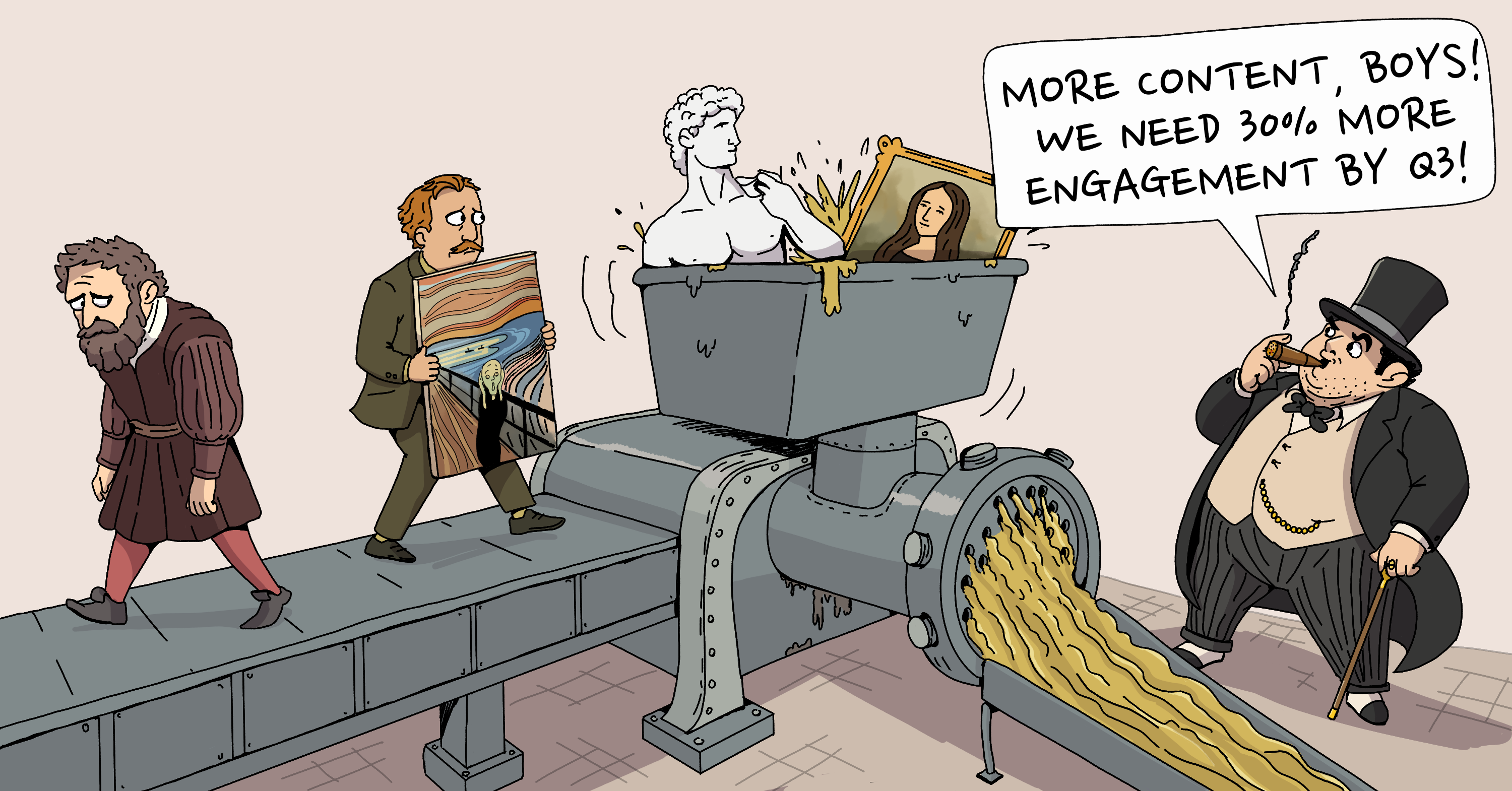
Michael Lynch writes about software and entrepreneurship at mtlynch.io and is working on a book about developer writing. The Michelangelo gag that opens his post is the hook; the substance is a running list of business words he quietly retired from describing his own one-person operation, and why each swap changed how he thought about the work.
"Traffic" became "readers," he explains, because readers reminded him these are real people who have billions of other things they could be reading that day, and chose him instead. "Users" got the same treatment. The pivot anecdote is smaller: an acquaintance described him as someone who "always sends me great leads." Meant as a compliment, Lynch realized the same sentence, read from the vendor's side, describes someone good at spotting gullible marks, which is why he now prefers "customer." He extended the logic further when a reader pushed back in the thread: a doctor telling a patient "I'm going to make so much money treating you" is technically accurate and still deeply unsettling, even when the treatment genuinely helps.
Lynch draws one line the title doesn't state: he has no issue with "content" as a bucket term for platforms. He doesn't expect YouTube's CEO to list "music, short film, art, comedy, journalism" every time he talks about the site's creators. The problem, in his framing, is individuals borrowing platform-scale language for work that was never generic to begin with.
The author's own answer to "isn't content just a useful bucket word?"
The debate split fast: readers who'd made the same swap in their own writing, against commenters who'd built entire identities around the word "content creator" and weren't giving it up. Lynch replied directly to the most common objection, that words like "traffic" and "users" are useful shorthand in general contexts:
"If I'm a blogger, I can just say "blogger" and it's more meaningful than "content creator" but I think the people running small businesses or doing creative work have needlessly adopted the big bucket terminology of "content."" — the essay's author, mtlynch
A sharper jab came from a reader who noted that Lynch's own blog "looks more like content than David" by his own definition. He didn't dodge it:
"I'm not trying to argue that art is sacred and we have to hold it up over everything else, but I am joking that there is still an implicit boundary where we don't use "content" to refer to things that we respect highly." — the essay's author, mtlynch
"It removes the artificial boundaries": the strongest disagreement in the thread
The most detailed rebuttal argued the opposite of Lynch's whole premise, that the catchall term is a feature, not a flattening.
"I actually really like the term content creator, because it removes the artificial boundaries that come with being a writer, photographer, filmmaker, etc. and just lets you make stuff… while Michelangelo did think of himself as an artist and a sculptor and painter, those professions were basically tradesmen at the time. The concept of high art… didn't come for centuries after his life." — a reply further down the thread
The historical point cuts both ways: if "artist" itself used to mean tradesman, today's "content creator" might just be next century's respectable word.
A musician and a former artist independently make the same complaint
Bob Nystrom, who wrote Crafting Interpreters and now works on Google's Dart language, has the identical reaction to a different industry's catchall word:
"I make electronic music as a hobby, and I feel the same way about the term "producer"… it still feels like such a soulless term. And most "producers" today are just sitting at home alone with a laptop and Ableton, so the role is very different than it was." — Bob Nystrom, author of *Crafting Interpreters*
A self-identified software engineer and longtime Apple developer pushed back on the "medium doesn't matter" framing directly:
"As an artist (former, really), I can confirm that the medium really, really matters. It can inform the creation, as much as the creator… Michelangelo was quoted as saying something like he "saw the statue in the stone," and that was why selecting the rock was as important as any other part of the process." — a self-identified software engineer and longtime Apple developer
Further down, a reader surfaced a much older version of the same argument. In a 2002 essay, Richard Stallman objected to "content" for reasons that have nothing to do with AI or platforms:
"using the word as a noun to describe works and communications through which people have expressed themselves adopts an attitude you might rather avoid: it treats them as a commodity whose purpose is to fill a box and make money. In effect, it disparages all the works by subordinating them to the box that is full." — Richard Stallman, in a 2002 essay a reader surfaced
The thread's sharpest irony landed off to the side
One reader called the post itself well-written but strangely empty, saying it manages to "convey nothing meaningful" despite reading easily. Another commenter didn't hesitate to say why:
"It's AI slop, that's why." — a later reply, more bluntly
Fair or not to Lynch's actual prose, it's the sharpest possible reversal for an essay arguing that individuals should describe their work with more specific, human words: part of the audience read it and reached for the least specific, least human label available.
Get breakdowns like this every day
The top Hacker News stories, unpacked — by email, Telegram, or RSS.
Airbus's exit from AWS keeps one system running on rebranded Palantir
Airbus is moving roughly 900 applications off AWS onto France's Scaleway, citing digital sovereignty. One system stays exactly where it is: Skywise, the aviation-data platform a former Palantir engineering lead in the thread identified as Palantir Foundry under a different name.