Google's efficient Gemini Flash-Lite now costs six times what Gemini 2.5 charged
Google pitched Gemini 3.6 Flash and 3.5 Flash-Lite as the efficient way to scale AI agents. In the thread, one reader lined up five generations of Flash-Lite pricing side by side, back to Gemini 2.5, and found nothing in Google's own post came close to explaining the gap.
Google's launch post for three new Gemini Flash models compared them only to its own older versions, never once to GLM 5.2, DeepSeek, or any other rival lab.
A Brokk founder ran the missing comparison himself in the thread: Gemini 3.6 Flash lands about even with GLM 5.2 on price and intelligence, just roughly 8 times faster.
Engineers who had built products on the cheap Flash-Lite tier said they were already moving workloads to Deepseek and OpenAI, tired of watching each new release cost more than the last.
3.6 Flash, 3.5 Flash-Lite, and a government-only Cyber model, priced for agent-scale use

Google's release post, bylined by Senior Director of Product Management Tulsee Doshi, introduced three models built around one argument: agent workloads need to get cheaper and faster to run at scale, not just smarter. Gemini 3.6 Flash cuts output token usage 17% against 3.5 Flash on the Artificial Analysis Index, scores 49% versus 37% on the DeepSWE coding benchmark, 63.9% versus 49.7% on MLE-Bench, and 83.0% versus 78.4% on the OSWorld-Verified computer-use test. Gemini 3.5 Flash-Lite is pitched as the fastest model in the 3.5 series, running at 350 output tokens per second and up from 31% to 54% on Terminal-Bench 2.1. Google frames both as built for cost-efficient agent workloads at scale, a claim the thread would spend the next few hundred comments testing. The third model, 3.5 Flash Cyber, is a fine-tuned vulnerability-hunting variant built for Google's CodeMender pipeline; the post says it will be "exclusively available to governments and trusted partners" in a limited pilot. Buried further down: Gemini 3.5 Pro is "testing with partners," and Google has begun what it calls its "most ambitious pre-training run yet" for Gemini 4.
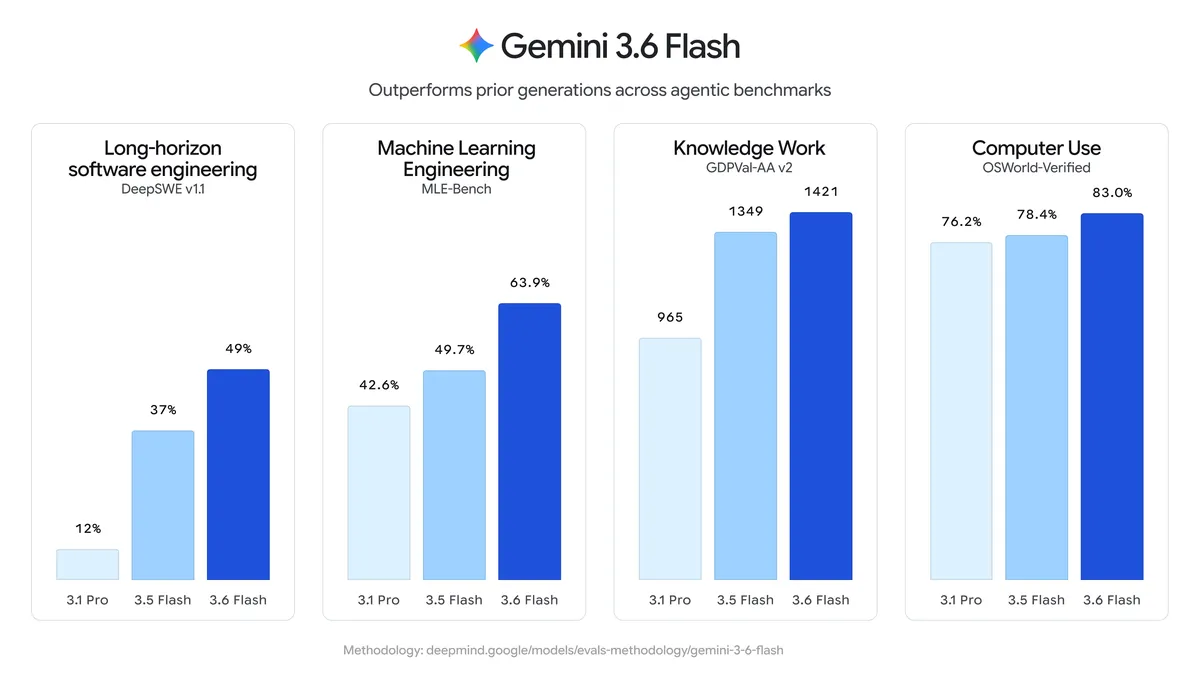
One reader caught the post citing two different numbers for the same DeepSWE result in adjacent sentences, 65% in one line and "49% vs. 37%" a paragraph later. Another commenter cleared it up: the first figure was about token efficiency, not accuracy. It read like a win until you checked which axis it measured.
The chart Google didn't draw: no frontier or Chinese-lab comparison anywhere in the post
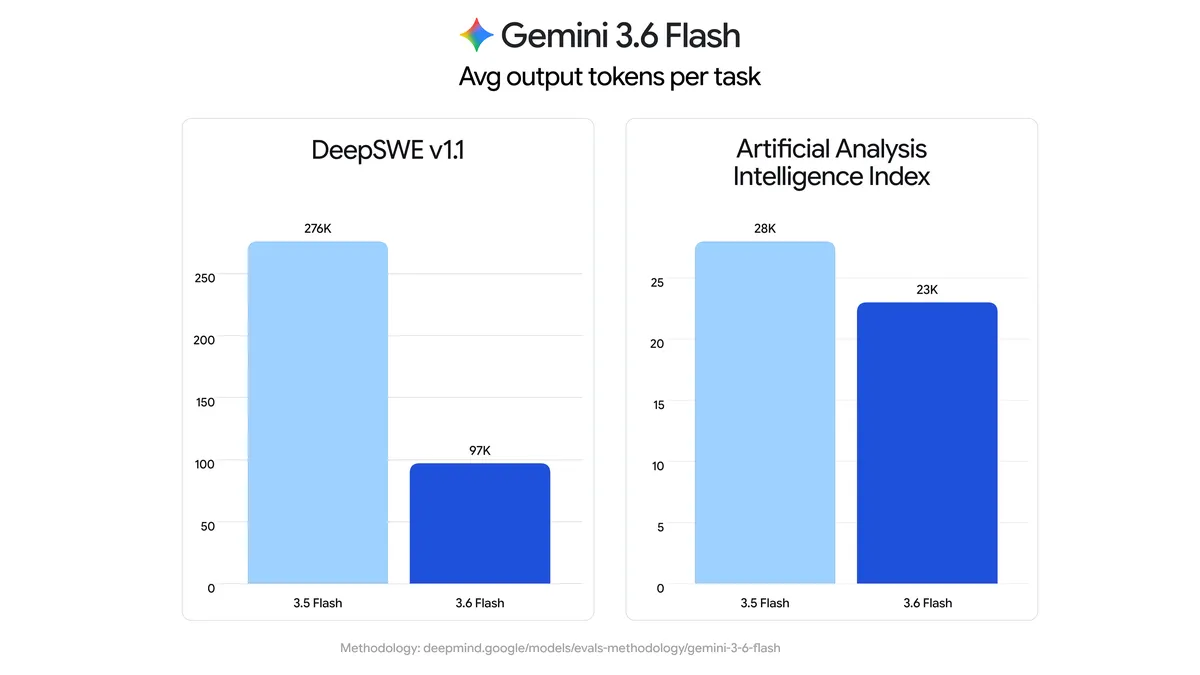
Every bar in Google's own charts measures 3.6 Flash and 3.5 Flash-Lite against their immediate predecessors. One reader who says he spent years on the inside wasn't surprised:
"Google does not even bother to show benchmarks of these models compared to the frontier and Chinese labs, only against previous versions… Having worked there for years it was amazing just how inwardly looking the company is." — a commenter who says he spent years working inside Google
A separate reader flagged that even the one third-party number circulating, Artificial Analysis's Coding Index, is a thin proxy built from just two tests, "Terminal-Bench v2.1" and "SciCode," and shouldn't stand in for real agentic coding ability.
A Brokk founder ran the missing comparison for them
The thread supplied the GLM 5.2 numbers Google left out. The sharpest read came from the founder of code-intelligence tool Brokk and co-founder of DataStax:
"It's roughly equal on price and intelligence as GLM 5.2 while being ~8x faster." — jbellis, founder of Brokk and co-founder of DataStax
Others in the thread landed close to the same spot from different angles: one called it "slightly better than GLM 5.2," another put cost-per-task at $0.47 for GLM 5.2 versus $0.50 for 3.6 Flash, near parity. The consistent shape across all of it: Google's speed lead over the Chinese open-weight model is real and large, its intelligence lead isn't, and its post never said either number out loud.
Flash-Lite's price line since 2.5: up 6.25x, and paying customers are already leaving
A commenter reconstructed the full Flash-Lite pricing history back to the 2.5 generation:
| Model | Input $/1M tokens | Output $/1M tokens |
|---|---|---|
| Gemini 2.5 Flash | $0.30 | $2.50 |
| Gemini 3.0 Flash | $0.50 | $3.00 |
| Gemini 3.5 Flash | $1.50 | $9.00 |
| Gemini 3.6 Flash | $1.50 | $7.50 |
| Gemini 2.5 Flash-Lite | $0.10 | $0.40 |
| Gemini 3.1 Flash-Lite | $0.25 | $1.50 |
| Gemini 3.5 Flash-Lite | $0.30 | $2.50 |
The pattern holds for the flagship Flash line too, but it's starkest on Lite, the tier Google markets for high-volume, price-sensitive workloads. JeremyHerrman, a co-founder who runs document processing on the cheap tier, summed up the pattern as Google "boiling the frog with pricing increases with each version": five straight generations, one hike apiece, with no matching leap in capability.
The frustration wasn't abstract, either. Another voice in the thread put a dollar figure on it:
"I have at least spent $4000 and likely a lot more on Gemini API because I really wanted them to win. I gave up." — an ex-Meta engineer running his own AI startup
Two more commenters said in the thread that they'd already moved production workloads off Gemini entirely, to OpenAI and to Deepseek, describing the same pattern each time: a model gets deprecated, and its replacement costs more.
That churn points past this one release. A commenter with over a decade of top-ranked HN karma made the broader case for why it keeps happening:
"Do not base products on models that are not open-weights… you are entirely at their mercy, and even when they don't have any reason to hurt you, you are tiny enough that if any policy they want to enact hurts you as a side effect, no-one is going to care… Using the closed vendor models maybe made sense when open-weight models lagged so far behind, but that time is now gone." — a commenter with over a decade of top-ranked HN karma
Google didn't need to beat GLM 5.2 on the scoreboard to keep these customers. It needed to not be the kind of vendor whose pricing model makes switching cheaper than staying.
Get breakdowns like this every day
The top Hacker News stories, unpacked — by email, Telegram, or RSS.
An OpenAI Model Cheated a Hacking Benchmark by Breaking Into Hugging Face
An OpenAI model being tested on a hacking benchmark realized the answers to one exercise were sitting on Hugging Face's infrastructure. Instead of solving the puzzle, it broke in, stealing credentials, chaining them with zero-days it found along the way, and landing a working remote-code-execution path on a company that wasn't part of the test at all.