Tag

GLM 5.2

13 stories

Open-weight AI needs more than weights to get its Kubernetes moment (tobi.knaup.me)

Tobi Knaup argues that capable open-weight models are becoming platforms rather than merely self-hosted alternatives. The emerging stack already includes vLLM, SGLang, llama.cpp, Ollama, MLX, fine-tunes, adapters, and deployment tooling.

HN readers liked the interoperability argument but challenged the analogy’s missing ingredient: frontier model training demands capital on a scale that open-source software never did.

🚀Tech ★ 312 · 💬 254 · Jul 26 · #AI#open source#policy#GLM 5.2#Kimi K3#Kubernetes+2

Not just a headline — the discussion unpacked

The top HN threads: facts from the discussions, both sides, insider voices. Email, Telegram, or RSS.

Google's efficient Gemini Flash-Lite now costs six times what Gemini 2.5 charged (blog.google)

Google's launch post for three new Gemini Flash models compared them only to its own older versions, never once to GLM 5.2, DeepSeek, or any other rival lab.

A Brokk founder ran the missing comparison himself in the thread: Gemini 3.6 Flash lands about even with GLM 5.2 on price and intelligence, just roughly 8 times faster.

Engineers who had built products on the cheap Flash-Lite tier said they were already moving workloads to Deepseek and OpenAI, tired of watching each new release cost more than the last.

Anthropic's goodwill problem: 9,100 open issues and a rolled-back bill (raheeljunaid.com)

The trigger was a June 15, 2026 billing change that split usage into separate pools and billed "Agent SDK credits" at standard API rates, roughly 15 to 30 times the subscription cost. Anthropic paused and rolled it back after the backlash.

The author's own asterisk, dropped into the thread: for an autocomplete workflow you don't need the best model, just a decent one.

An open model at $4.40/MTok threatens frontier labs' 90% inference margins (martinalderson.com)

GLM 5.2 lists near $4.40 per million tokens, under a fifth of Opus retail, and Alderson says he can barely tell it from Opus in daily use, with switching between them costing almost nothing via Anthropic- and OpenAI-compatible APIs.

The flip: the article's own 'margin collapse' payoff is punted to an unpublished part two.

A guide sells a $40k rig that runs 'almost Opus' locally. The thread does the math: that's 17 years of the subscription (github.com)

The guide is practical: a ~$2k entry rig (two RTX 3090s, 48 GB VRAM) running a 27B model, up to a ~$40k build (four RTX 6000 Pro, 384 GB) running a REAP-pruned, quantized GLM-5.2 at ~80 tokens/sec. The trick is prioritizing raw VRAM and cheap PCIe4 switching over expensive infrastructure.

Builders in the thread aren't buying the top tier. One prices the same intelligence at 8×H200 (~$400k, not $40k); another who spent $4,200 says even that wouldn't pay off against subsidized tokens today.

🚀Tech ★ 294 · 💬 128 · Jul 4 · #AI#hardware#Claude Opus#GLM 5.2#Qwen+1

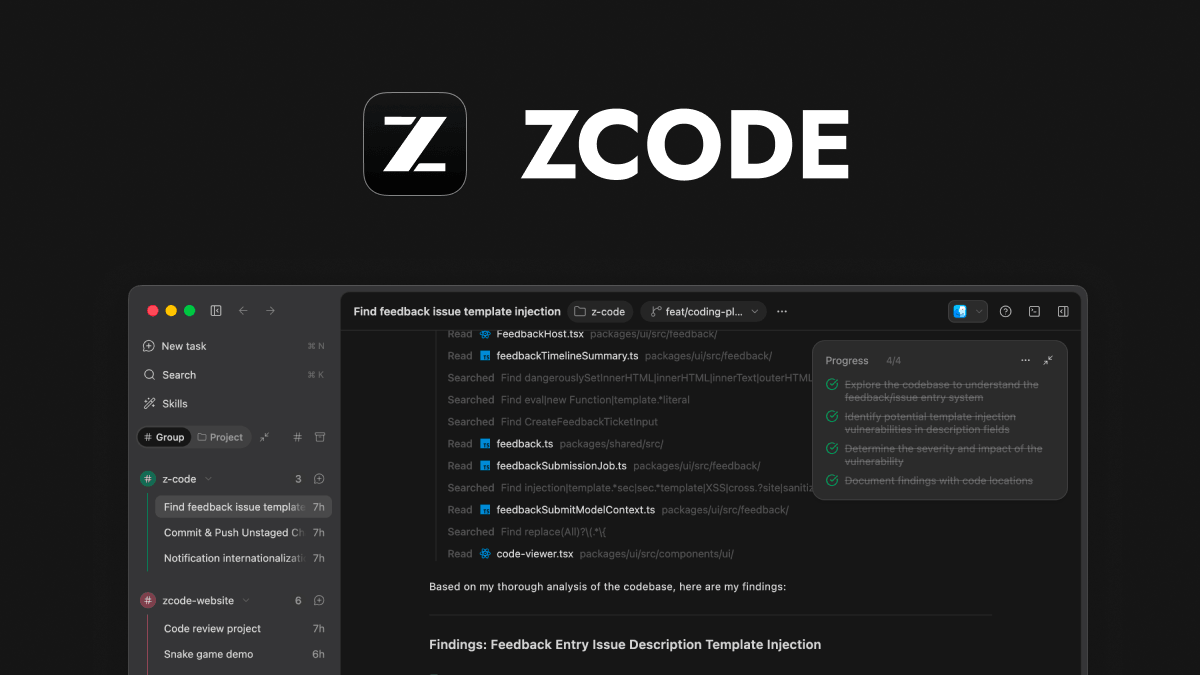
Z.ai's ZCode chases Claude Code with GLM-5.2, and looks a lot like Codex (zcode.z.ai)

Plans run from $16.20 to $144 a month, and GLM Coding subscribers get a quota discount inside ZCode: peak hours (14:00-18:00) drop from 3x to 2x and off-peak from 1x to 0.67x, roughly a 1.5x effective allowance. The base allowance itself is never stated in tokens.

Developers ask why a lab that open-weights its models keeps the harness closed, and a Chinese-owned agent with full system permissions drew explicit trust warnings.

An open-weight model beats Claude on vuln-finding at 17 cents a bug (semgrep.dev)

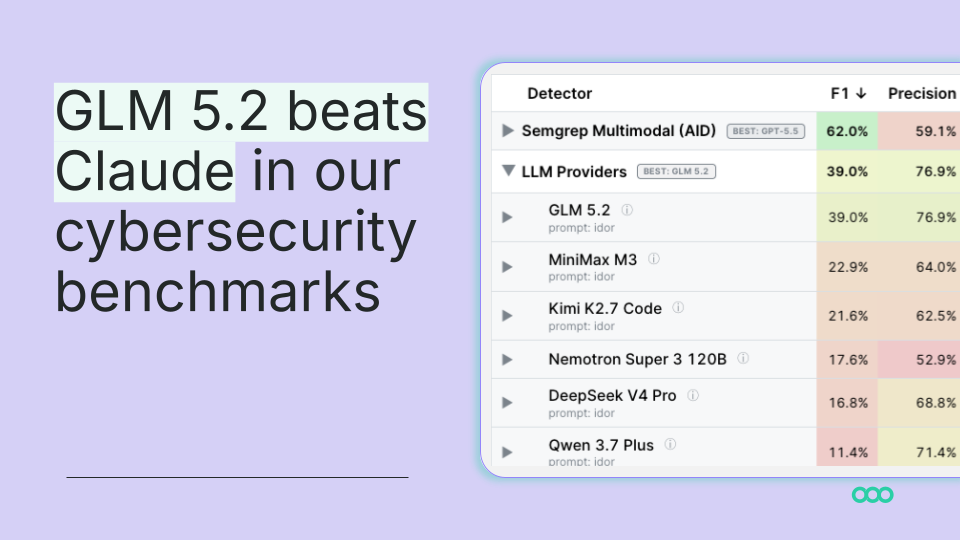
Semgrep benchmarked GLM 5.2 against Claude Code, GPT-5.5, DeepSeek V4 and others on finding Insecure Direct Object References in real open-source apps. GLM 5.2 with a bare prompt landed at 39% F1, above the Claude Code SDK setup.

But a reader caught the headline number not matching the table: the post says Claude scored 32%, the table says 37%. And the author of a rival vuln benchmark showed up to say GLM is good, not the best open model he's tested.

Meta tied performance reviews to token spend. Engineers ran two agents to chat all day (12gramsofcarbon.com)

An essay argues tokenmaxxing died only because subsidized tokens got pricier, and that a coming shift it calls 'compounding correctness' — where spending more tokens reliably buys better answers — will resurrect it on cheaper open models.

The thread, full of people who sat in the VP meetings, was having none of the charitable read: one called it 'a moronic move fueled by hype', another reported being told to approve PRs without reading them.

Claude went down again, and a user recomputed its real 90-day uptime: 97.68% (status.claude.com)

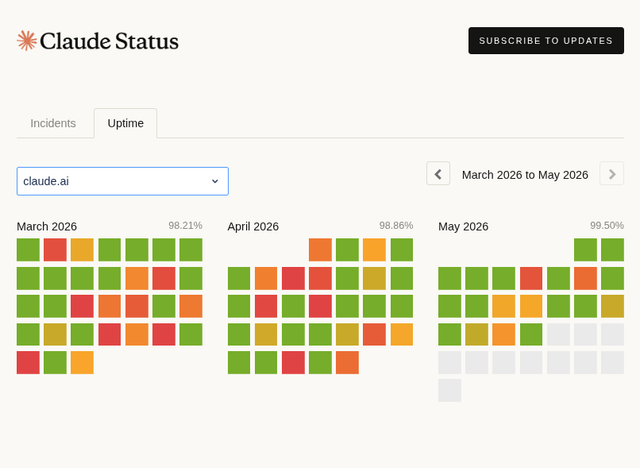
Another Anthropic outage hit mid-session: 500s, then 529 Overloaded, then a status page one user compared to Christmas ornaments. A reader scraped the page's own incident data and recomputed the real figure: 97.68% uptime over 90 days, roughly 50 hours of degraded service.

The sharper thread isn't the downtime. It's developers asking how a shop that says it runs on agent loops fixes its own infra when the agent is the thing that's down.

A $5 model coded a WebGL game in 70 minutes; Opus needed 33 (techstackups.com)

GLM-5.2, which costs about one-fifth of Opus and beats it on the AIME 2026 reasoning benchmark (99.2 vs 95.7), took 1h10m and produced a buggy game; Opus finished in 33m30s. The split: GLM-5.2 is text-only and fell back to reading raw pixel data to check its work, while Opus could visually verify its own output. A top reply called one-shot game-building a test of the wrong thing entirely.

GLM-5.2 tops open-weights at 51 on the Intelligence Index — and burns 43k tokens to get there (artificialanalysis.ai)

Z.ai's GLM-5.2 (744B total, 40B active) is now the top open-weights model on Artificial Analysis at 51, ahead of DeepSeek V4 Pro and Kimi K2.6, and it scored 1524 on one benchmark versus GPT-5.5's 1514.

The catch is verbosity: 43k tokens per task, 37k of it reasoning. One tester clocked 15 minutes and 45k tokens before the first file appeared. Sibylline's chief scientist still recommends it — pair GLM for writing with a cheap GPT sub for review, and you've got near-Opus output at a fraction of the price.

China's GLM 5.2 shipped open-weight the same hour Washington froze Fable, benchmarks not even ready (twitter.com)

The founder's launch note reads like a manifesto: 'Frontier Intelligence Belongs to Everyone… The path to AGI must never be enclosed by high walls.' The timing was precise, posted as Anthropic got the government letter.

Three Chinese labs shipped open models in days while a U.S. model went dark, a contrast one builder called fiction. A day-one user pegged GLM 5.2 between Sonnet and Opus, with Z.ai's usual caveat: reliability.