OpenCode's leak hit stored API keys, not the coding agent most users run
OpenCode's team told customers that a legacy system they were decommissioning had been accessed and that stored OpenAI and Anthropic keys 'may have been exposed'. The confusion that followed was about which OpenCode this was.
The breach is in 'OpenCode Console', an OpenRouter-like service where users paste provider API keys so it can proxy their requests. People running only the open-source terminal agent or desktop app are not affected.
Several commenters noted the Console had no visible privacy policy or terms of service and that the team's announcement never drew that line.
What the OpenCode team told customers
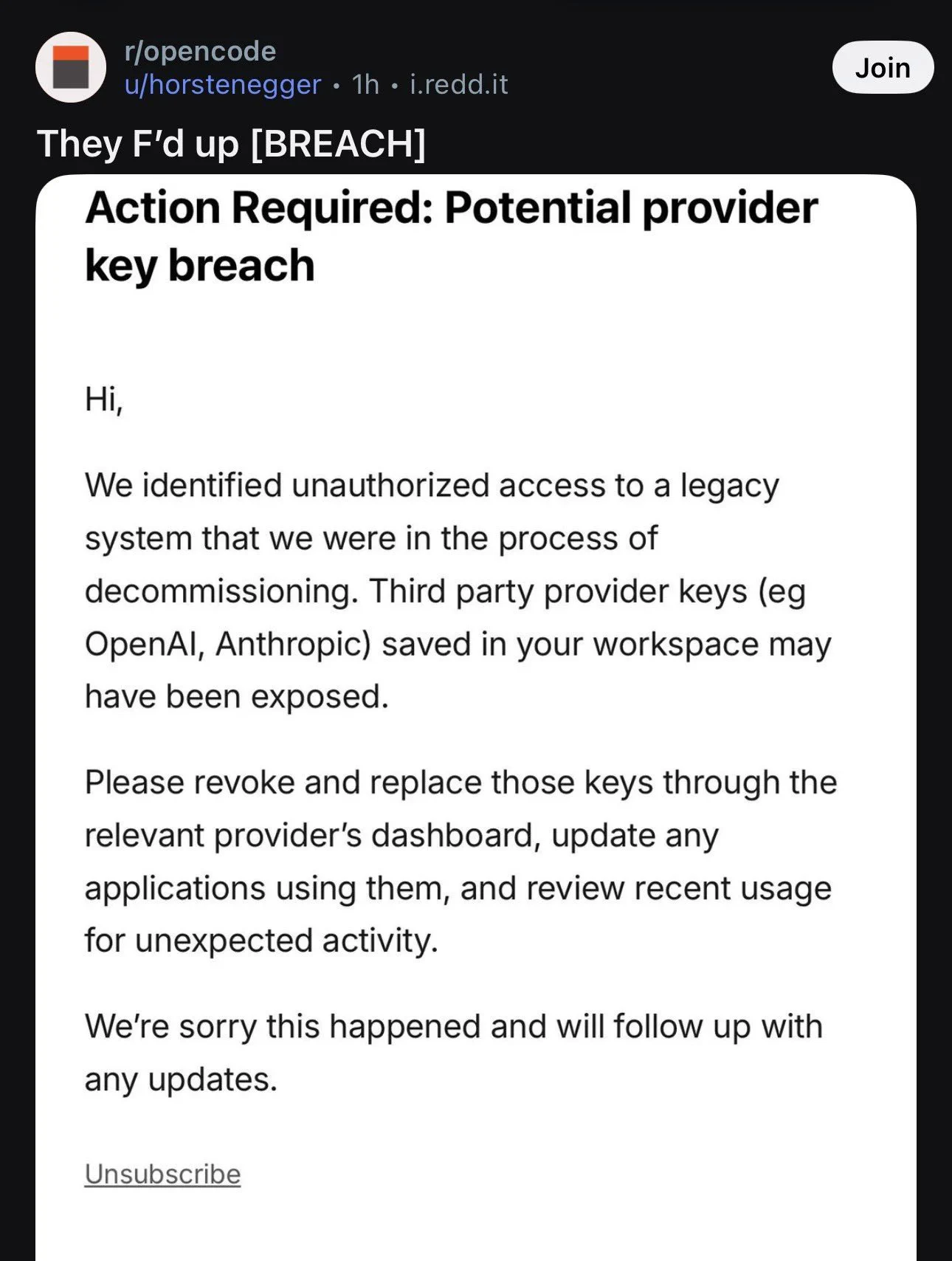
The announcement on X was reposted in the thread by a reader. The team wrote that it "identified unauthorized access to a legacy system that we were in the process of decommissioning" and that third-party provider keys, such as OpenAI and Anthropic, saved in a workspace may have been exposed. Customers were told to revoke and replace keys, update applications, and review recent usage.
Which OpenCode was breached
"The leak was for something called 'OpenCode Console', which is distinct and separate from the OpenCode coding agent." — Aaron Maxwell, author of Powerful Python
His complaint was about communication: the product has almost no documentation, and the announcement does not make the distinction. Another reader listed the many things "OpenCode" has meant over recent months, from the terminal agent to the desktop app, with docs that lagged the v1-to-v2 transition.
Why keeping keys there was always a risk
A commenter who walked through the Console's signup described a page that lists providers and asks you to paste an API key. How the keys are stored is not explained, and he found no links to terms of service or a privacy policy. His analogy: it is like handing someone a password or private key to hold for you.
Another reader raised that sandboxing agents in virtual machines would not have helped here, while a proxy that hides keys from agents might have.
"Any sensible engineer that uninstalled this 6 months ago and used codex and claude code directly also avoided this." — a backend developer with 10+ years in C and Python
Plans that bundle cheap models were the practical worry: a user who pays $10 a month for subsidized access to Qwen said this was the second trust problem he had seen from the project and was now looking for alternatives.
Takeaway
If you pasted keys into the Console, rotate them now; if you only run the agent, check nothing else was shared with that workspace.
Get breakdowns like this every day
The top Hacker News stories, unpacked — by email, Telegram, or RSS.
Estonia published its online voting source code, and HN argued about whether code can prove a vote counted
Estonia has a public repository for IVXV, the system behind its legally binding online elections. The fight was over what readable code can and cannot prove to a voter.