DuckDuckGo's founder shows up to argue 21% adoption isn't "everyone using AI"
The post takes apart the 2025 headline that "everyone is using AI for everything." In the thread, the author defends his numbers — and a guy who used ChatGPT to claw back $6,500 from his roofer shows up to disagree.
Gabriel Weinberg's data: 86% of desktop users hit a search engine 10+ times a month; only 21% touch AI chat tools that often. His framing — people consume AI like they eat meat: some embrace, some limit, some avoid.
Simon Willison called the headline a strawman but flagged the Microsoft stat — 30% of the US working-age population using AI 90+ minutes a month — as "impressively" high. Then practitioners split on whether the tools even work.
The headline being argued with is over a year old
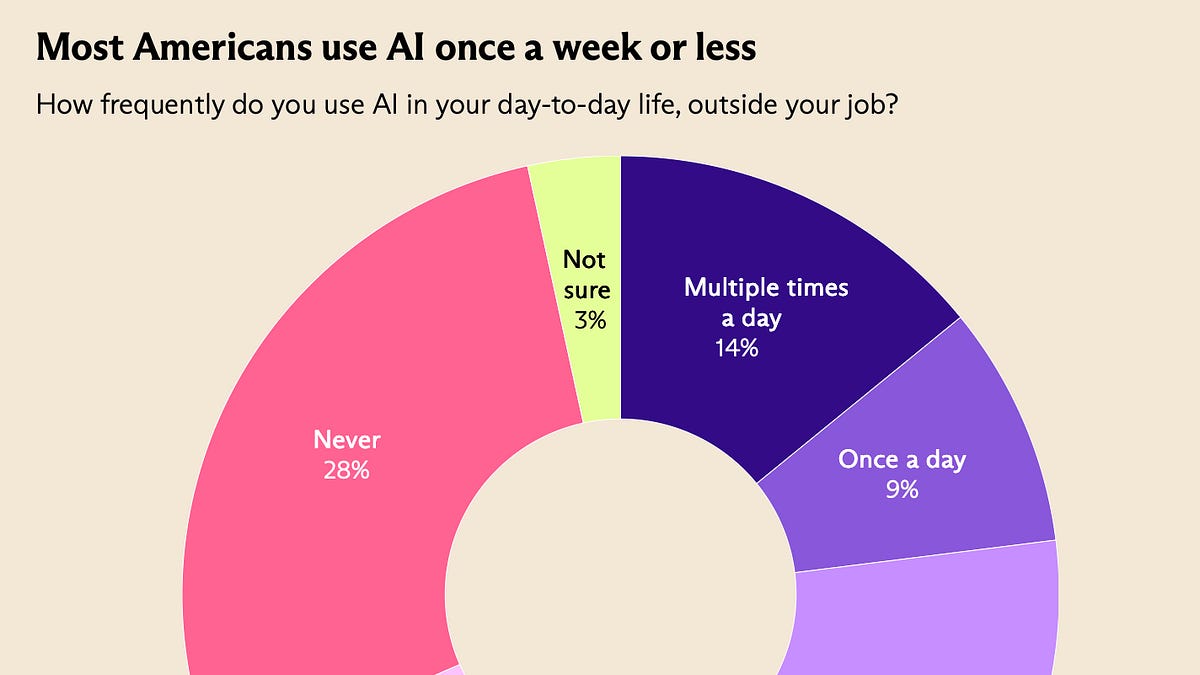
The post is a retrospective on a 2025 line, "everyone is using AI," by Gabriel Weinberg, the founder of DuckDuckGo. His argument is that the word everyone is doing dishonest work. The Datos data he cites: on desktop, 86% used a traditional search engine more than 10 times a month against only 21% for AI chat tools, more than 4x less. A Microsoft paper puts 30% of the US working-age population at 90+ minutes of AI use in a month. Gallup has Gen Z anger at AI up 40% year over year.
The titular analogy: people consume AI like they eat meat. Roughly a third embrace it, a third use it occasionally, a third avoid it: the same distribution as Americans who eat meat but cut red meat, go vegetarian, or go vegan. The conclusion isn't ignorance; it's deliberate restraint.
Willison: "impressed at how high that number is"
The most-cited voice in the thread thought the framing was weak but the data worth keeping.
"Bit of an odd decision to build an entire article around a clickbait headline from July 2025 … That aside … 30 percent of the US working-age population is using AI [...] I'm honestly impressed at how high that number is! That's a lot of adoption for a technology that didn't exist four years ago" — Simon Willison, creator of Datasette
Weinberg himself joined to defend the precision of his own piece. The whole point was that "everyone" never meant everyone:
"on desktop 86% were using traditional search engines >10 visits/month vs. only 21% for AI chat tools. That is indeed a very significant percentage, but more than 4x less than search and … wouldn't say that ~1/5 is 'everyone'" — Gabriel Weinberg, founder of DuckDuckGo
The roof-claim guy versus the engineer who sees no value
Then the thread split on whether the tools deliver, and the split ran through concrete personal stories. The most vivid was a list of real-world wins from outside software entirely.
"I'm getting my roof replaced due to hail damage. Insurance originally covered only $5k … I fed the insurance policy to AI. I learned about the appraisal clause and invoked it. At the end, I got another $6,500 back" — a commenter who also used it to renegotiate $35–55k plumbing quotes
Against that, a sharp dissent that even the home turf is overstated:
"Software engineers aren't even all using AI, contrary to frequent claims here that they are. There are very many who have tried it, found it didn't add value … and aren't using it unless FOMO-driven managers force them to" — bigstrat2003
What "using AI" hides: a contractor's view from inside
The most useful insider note came from someone paid to install it. A contractor who builds predictive systems described the demand as detached from need:
"quite often there is a specific request to put AI into it even when it is not needed and would objectively make the system worse, slower and more expensive. The AI psychosis is a real thing" — a contractor who builds predictive workflows
And an Apple-platform developer who self-identified gave the cleanest case study of the split living inside one project: the LLM wrote PHP backend code "better than what I would write," and frontend Swift that was "terrible … It really needs adult supervision." Another engineer immediately diagnosed it: PHP's corner cases are documented across decades; Swift is newer, so the training data is thinner.
The real disagreement isn't the number
Weinberg's stat survives the thread mostly intact — 21% is not everyone, and Willison's grudging 30% doesn't change that. What the thread surfaces is that the headline fight is a proxy. The roof-claim commenter and the FOMO-skeptic engineer aren't disagreeing about adoption rates; they're disagreeing about whether the same tool that recovers $6,500 from an insurer can be trusted to write production code. The honest answer the thread keeps circling: it depends entirely on whether the task has documented rules — and most of the world doesn't.
Get breakdowns like this every day
The top Hacker News stories, unpacked — by email, Telegram, or RSS.
"100k before lunch": a post says the usable context window is a fraction of the box number
The advertised 1M-token window is mostly marketing, the author argues — there's a smart zone of about 100k and a dumb zone after. Practitioners showed up with their own thresholds, and they don't agree on a single one.