GLM-5.2 tops open-weights at 51 on the Intelligence Index — and burns 43k tokens to get there
Z.ai's GLM-5.2 scored 51 on Artificial Analysis's index, the best open-weights model and within a point of GPT-5.5 on one benchmark. It spends 43k tokens per task to do it, and one tester watched it reason for 15 minutes before writing a single line of code.
Z.ai's GLM-5.2 (744B total, 40B active) is now the top open-weights model on Artificial Analysis at 51, ahead of DeepSeek V4 Pro and Kimi K2.6, and it scored 1524 on one benchmark versus GPT-5.5's 1514.
The catch is verbosity: 43k tokens per task, 37k of it reasoning. One tester clocked 15 minutes and 45k tokens before the first file appeared. Sibylline's chief scientist still recommends it — pair GLM for writing with a cheap GPT sub for review, and you've got near-Opus output at a fraction of the price.
A 744B open model lands a point behind GPT-5.5
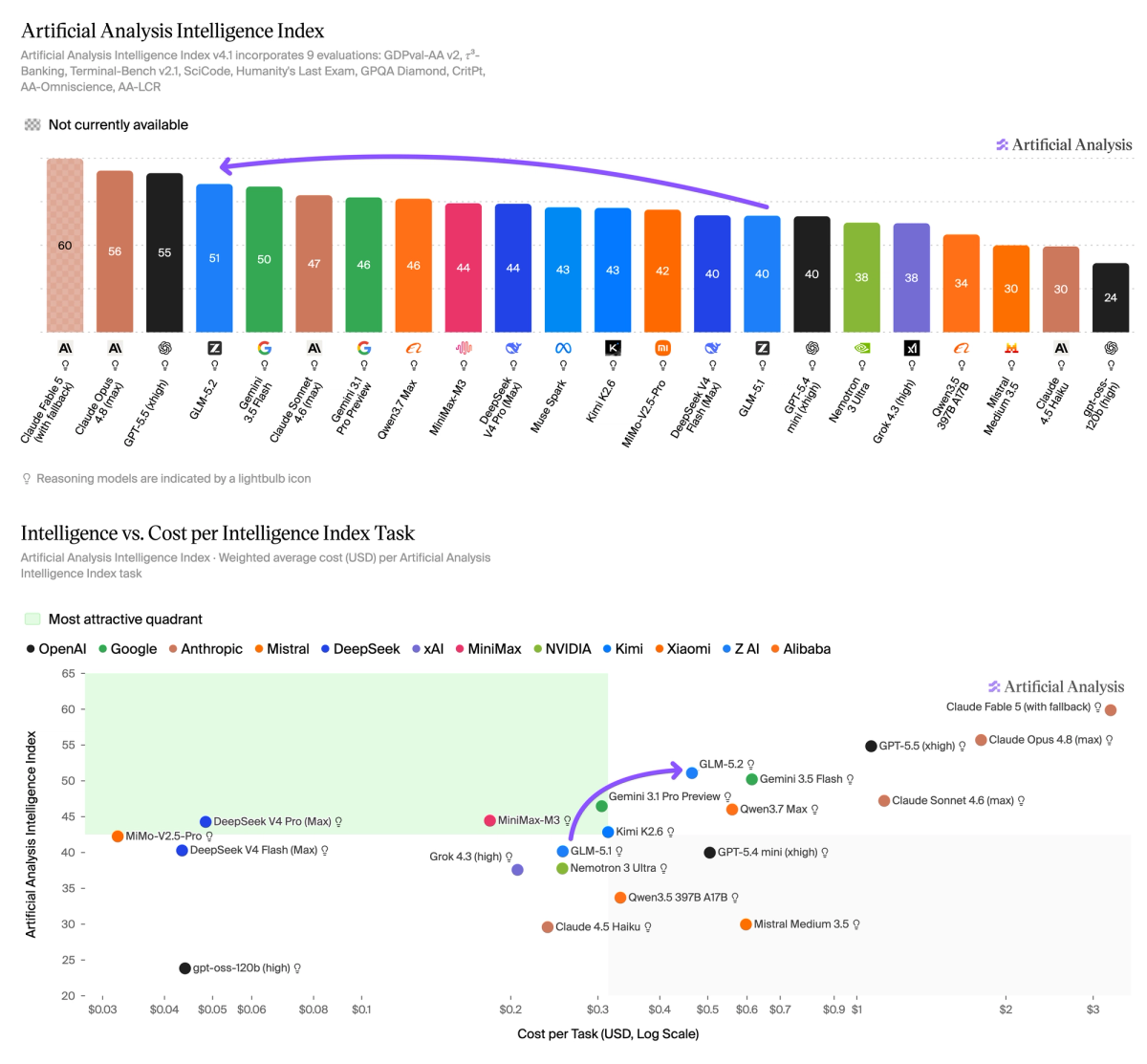
Artificial Analysis's report is blunt about it: Z.ai's GLM-5.2 is the strongest open-weights model they've measured. It scores 51 on the Intelligence Index v4.1, clear of the next open models — MiniMax-M3 and DeepSeek V4 Pro at 44, Kimi K2.6 at 43. The architecture is a 744B-parameter mixture-of-experts with only 40B active, and the context window jumped to 1M tokens from 200K.
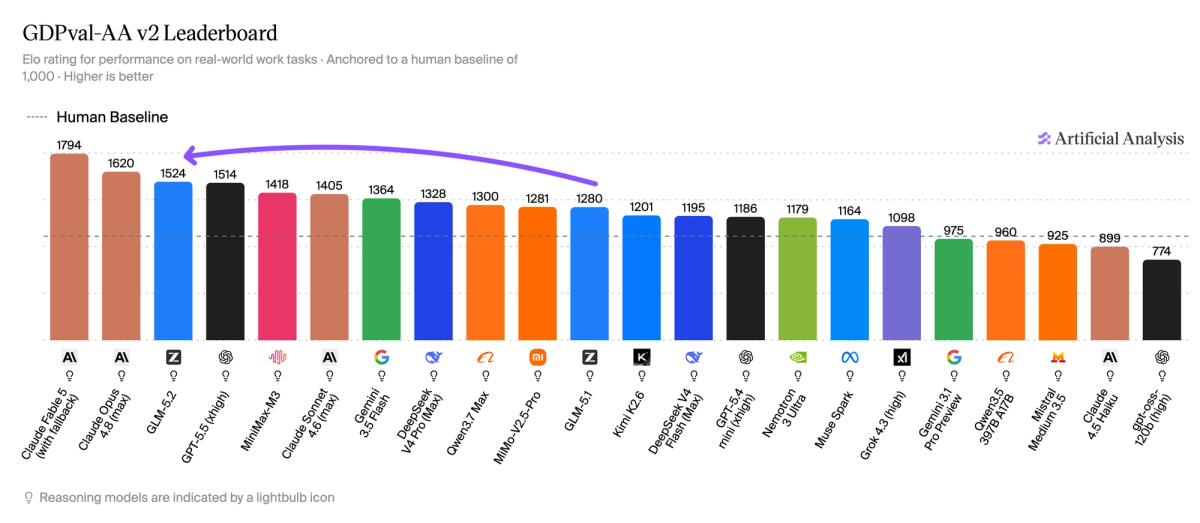
The more eye-catching number is the GDPval-AA v2 benchmark, where GLM-5.2 hit 1524 against GPT-5.5's 1514 — an open-weights model nudging past a frontier proprietary one. Scientific-reasoning gains were large: +16 points on CritPt, +16 on TerminalBench v2.1 to 78%.
The asterisk is in the token bill
Artificial Analysis itself flags the cost: GLM-5.2 sits "off the most attractive quadrant on the Intelligence vs Output Tokens chart." It spends 43k output tokens per task, 37k of it pure reasoning. The intelligence is frontier-adjacent; the efficiency is not.
That abstract chart point became a concrete complaint in the thread. One tester ran his standard probe — a small math-evaluator library in Nim, 400–600 lines — and watched the model think itself in circles:
"GLM 5.2 (xhigh…) spent over 15 minutes (!) reasoning, spending about 45k tokens, before it finally wrote the first file… GPT 5.5 xhigh spends 16k tokens total on average" — a developer who benchmarks models on a fixed Nim coding task
The cost-per-task math also drew a squint. The report puts GLM-5.2 on the Pareto frontier at ~$0.46 per task, but one reader laid the numbers side by side: GLM-5.1 was $0.25, Kimi K2.6 $0.31, MiniMax-M3 $0.18, and DeepSeek V4 Pro just $0.05 — so "lowest cost at its intelligence level" is doing a lot of work.
The insider read: good enough to change your subscription stack
The most credentialed voice in the thread had spent a full day with it.
"it's quite capable, while being a little bit verbose (I've seen it reconsider things 3-4 times in thinking traces…), and not being quite as good as GPT5.5 at working through complex abstract requirements." — CuriouslyC, chief scientist and CEO of Sibylline Software
His practical conclusion is the real story for most users: a Z.AI subscription plus a $20/month OpenAI sub covers "all but the most AI-pilled multi-orchestrators or die-hard Claude fans" — GLM writes, GPT reviews and debugs, and it lands "minimally worse than just doing everything in GPT with the $200/mo plan."
Others were giddier. One pointed at the raw price-to-quality ratio: providers offering near-"Opus 4.7 quality" at unlimited tokens for $50 a month, with API rates well under the official Z.AI prices — "a huge blow to Anthropic/OpenAI/Google and a massive win for the rest of the world." A fintech engineer called it "a real step forward… very epistemically cautious in its reasoning."
The dissents: capacity, modality, and 'holding it wrong'
Not everyone was sold. The recurring practical gripe is that Z.ai can't keep up with demand:
"Ziphu really really struggle with capacity — everyone is complaining of timeouts or very slow speeds… the capacity issues means DeepSeek is my main provider these days" — a Lite-plan subscriber who can't get direct model access
A missing-modality note pointed out that neither DeepSeek nor GLM takes image input, which limits them on UIs, screenshots and photos. And the sharpest skeptic went after the benchmark hype itself: on Artificial Analysis's own coding-agent chart, GLM-5.1 on high was twice the cost and half the intelligence of GPT-5.5 on medium — "really makes me wonder how legitimate some of the internet noise is about open models."
The local-model clock is the thing to watch
Strip the leaderboard drama and one question keeps surfacing in the thread: how soon can a business run something this good on its own hardware? A near-Opus model running locally "in the next couple of months" no longer reads as fantasy, and several are weighing whether to buy GPUs for privacy and control rather than rent frontier APIs. GLM-5.2 isn't beating GPT-5.5 outright, and it pays for its intelligence in tokens. But "top open-weights model, one point behind frontier, runnable on your own boxes" is a sentence that didn't parse a year ago.
Get breakdowns like this every day
The top Hacker News stories, unpacked — by email, Telegram, or RSS.
60% of US consumers say 'AI' in brand messaging is a turnoff, and 61% can't name a brand doing it well
WordPress VIP surveyed 1,200 US consumers: 60% read 'AI' in a brand's pitch as a negative, 74% say the web feels less human than a decade ago, and 61% can't name a single brand using AI effectively.