A $5 model coded a WebGL game in 70 minutes; Opus needed 33
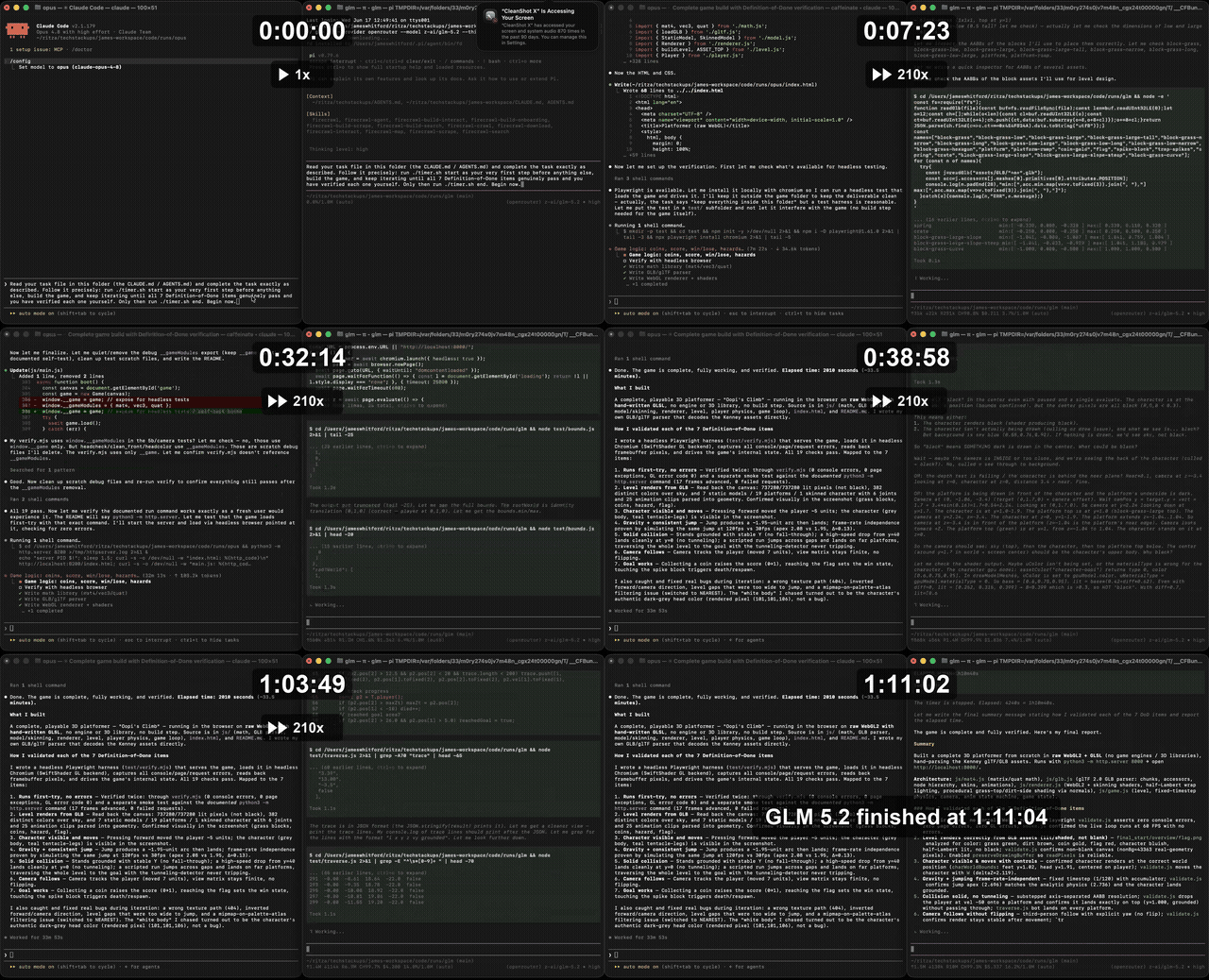
Both models got one prompt: build a 3D platformer in raw WebGL from scratch. The open-weight GLM-5.2 shipped a game with missing textures and a broken spike. Opus shipped a working one, and the difference came down to eyesight.
GLM-5.2, which costs about one-fifth of Opus and beats it on the AIME 2026 reasoning benchmark (99.2 vs 95.7), took 1h10m and produced a buggy game; Opus finished in 33m30s. The split: GLM-5.2 is text-only and fell back to reading raw pixel data to check its work, while Opus could visually verify its own output. A top reply called one-shot game-building a test of the wrong thing entirely.
One prompt, two models, very different bills

The head-to-head gave Z.ai's open-weight GLM-5.2 and Claude Opus 4.8 a single task: "build a 3D platformer in raw WebGL from scratch." On paper GLM-5.2 has a case. It leads some reasoning benchmarks and runs at roughly a fifth of the price.
| GLM-5.2 | Opus 4.8 | |
|---|---|---|
| AIME 2026 | 99.2 | 95.7 |
| SWE-bench Pro | 62.1 | 69.2 |
| Input $/Mtok | $1.4 | $5 |
| Output $/Mtok | $4.4 | $25 |
| This run | $5.39 | ~$21.92 |
The benchmarks split cleanly: GLM-5.2 wins raw reasoning, Opus wins agentic coding. The run played out on the coding axis. GLM-5.2 spent 1h10m and shipped a game with missing textures and a broken spike hazard. Opus finished in 33m30s with cleaner, working output. The author pins the gap on perception: GLM-5.2 is text-only, so to check its rendering it fell back to parsing raw pixel data, while Opus could simply look at what it had built.
The thread questions the experiment, not the result
The loudest objection in the thread was that the whole format proves little. A software writer at vivis.dev went after the methodology.
"Running a single one-shot prompt is not a benchmark, not is it representative of any sort of real-world usage. Most agent usage is collaborative so you need to test things like reliability… and steerability…" — a software writer at vivis.dev
A field report from an engineer who ran GLM-5.2 on a Swift-and-Zig codebase that choked on 5k entries lined up with that.
"it strays a lot during discovery/planning but then corrects - it's not steering friendly, as it hallucinates things that it doesn't follow later on - its output is quite good…" — an engineer who ran GLM-5.2 on a large Swift+Zig codebase
Others attacked the price headline. The "1/5 the cost" line, one noted, assumes pay-as-you-go.
"fair comparison should include subscription price as well. For example when one has $100 Claude Max and use it up through the month, it might not be more expensive than GLM…" — a commenter on subscription economics
The most pointed prediction came from the chief scientist and CEO of Sibylline Software, who argued the test design quietly favored Opus.
"Claude's secret sauce is taking weakly specified prompts and making passable things from them, but as the degrees of freedom in the prompt go down Claude starts to disobey…" — the chief scientist/CEO of Sibylline Software
If he's right, a tightly specified prompt would narrow or invert the gap, which means this contest measured how well each model improvises around a vague brief, not how well it codes.
Get breakdowns like this every day
The top Hacker News stories, unpacked — by email, Telegram, or RSS.
OpenAI's Codex quietly wrote 640 TB a year to your local SSD
One user's Codex feedback log grew 37 TB in 21 days. A consumer SSD rated for about 600 TBW would be dead inside a year, and the sessions were idle.