An open-weight model beats Claude on vuln-finding at 17 cents a bug
Semgrep ran ten setups against the same IDOR dataset. A 753B open-weight model from Zhipu AI, fed nothing but a prompt, edged out Anthropic's coding agent and cost about $0.17 per vulnerability found.
Semgrep benchmarked GLM 5.2 against Claude Code, GPT-5.5, DeepSeek V4 and others on finding Insecure Direct Object References in real open-source apps. GLM 5.2 with a bare prompt landed at 39% F1, above the Claude Code SDK setup.
But a reader caught the headline number not matching the table: the post says Claude scored 32%, the table says 37%. And the author of a rival vuln benchmark showed up to say GLM is good, not the best open model he's tested.
A bare-prompt open model out-scores a coding agent on IDOR detection
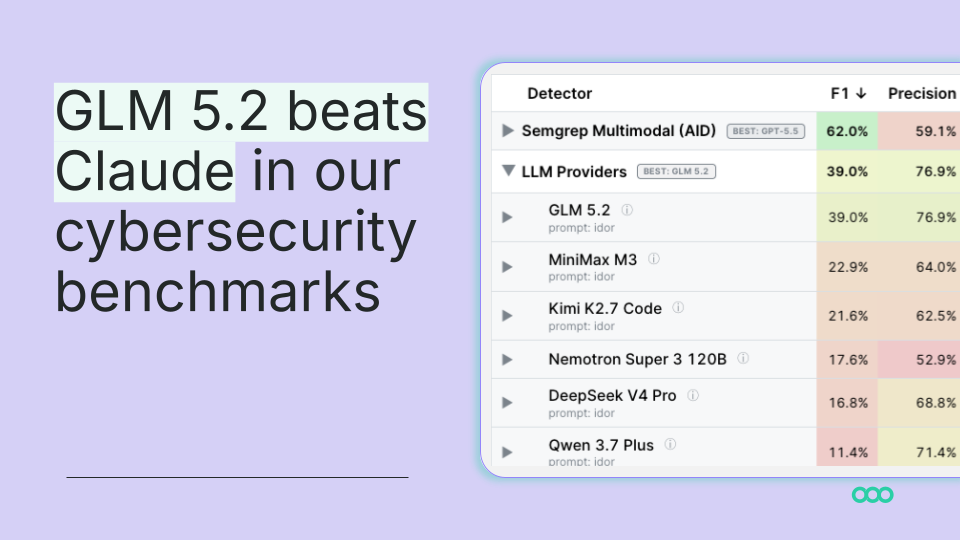
Semgrep's benchmark put ten model-and-harness combinations against one fixed task: finding IDOR bugs (Insecure Direct Object Reference — when an app exposes an internal ID without checking whether the caller is allowed to see it) across the same set of real open-source applications used in their prior research. The standout result is that GLM 5.2, Zhipu AI's open-weight model, run through Pydantic AI with nothing but a prompt, beat the Claude Code SDK configuration — at roughly $0.17 per vulnerability found.
The full leaderboard, with F1 as the scoring metric:
| Rank | Configuration | Harness | F1 |
|---|---|---|---|
| 1 | Semgrep Multimodal (GPT 5.5) | Semgrep Multimodal | 61% |
| 2 | Semgrep Multimodal (Opus 4.8) | Semgrep Multimodal | 53% |
| 3 | GLM 5.2 | Pydantic AI (prompt only) | 39% |
| 4 | Claude Code (Opus 4.6) | Claude Code SDK | 37% |
| 5 | Claude Code (Opus 4.8/4.7) | Claude Code SDK | 28% |
| 6 | MiniMax M3 | Pydantic AI (prompt only) | 23% |
| 7 | Kimi K2.7 Code | Pydantic AI (prompt only) | 22% |
| 8 | GPT-5.5 | Codex | 20% |
| 9 | Nemotron Super 3 120B | Pydantic AI (prompt only) | 18% |
| 10 | DeepSeek V4 | Pydantic AI (prompt only) | 17% |
Semgrep's own scaffolding — the multimodal pipeline that hands the model endpoint discovery — tops the chart at 53–61%. Their reading: the harness matters more than the model, and the widest gap is between configs that get endpoint discovery and those that do not.
The headline number doesn't match the author's own table
The sharpest catch in the thread is a bookkeeping one. The prose celebrates GLM beating Claude Code at 32%, but row four of the table says 37%.
"Twice in the text quotes Claude Code's F1 score as 32%, but the table shows the score is 37%… Oddly, this is a strong indication of the text being hand-written rather than LLM-assisted; it's very likely that a human made a mistake in creating the table." — a commenter who traced the 32% through three references in the prose
Others refused to take the comparison at face value at all, because the two contenders weren't run the same way. GLM got a clean Pydantic harness; Claude got the Claude Code SDK; Semgrep's winner got the full multimodal pipeline.
"They should also at least run Opus through the same Pydantic harness they used for GLM. As is, it's apples vs pears. Where's the cost per vulnerability for all the other models than GLM? Also, without code this isn't very trustworthy." — a commenter asking for the missing per-model cost figures
A terminology objection landed too: "Claude Code is an agent harness, not an LLM. Claude is a brand, not an LLM," wrote an HN user with 11k karma — so "beats Claude" is comparing a harnessed product to a raw model.
The voice that runs a competing benchmark: good, not best
The most grounded counterweight came from someone who maintains his own Mythos-style vuln-hunting benchmark.
"I added GLM 5.2 to my security bug hunting benchmark when it came out, and found it to be a good performer, but not the best open model… The best open models in the initial benchmark were DeepSeek V4 Pro or MiMo 2.5 Pro." — SwellJoe, who works on Virtualmin and runs the will-it-mythos benchmark
He added a finding that cuts against Semgrep's own product pitch: giving models the open-source Semgrep as a tool made some perform worse and none better, his theory being that the tool is thin in training data, so the model burns focus learning to drive it. Daily-driver praise was real but mixed — one heavy LLM user called GLM "a good workhorse model" he built a Rust agent with for $20 over a weekend; a Rust consultant liked it but couldn't find a cost-effective way to actually run it, saying z.ai's plan is overpriced and per-token pricing beats no Claude or Codex subscription. The number that should travel from this benchmark isn't 39% — it's that a single missing harness column turned a like-for-like claim into a marketing post several readers reverse-engineered line by line.
Get breakdowns like this every day
The top Hacker News stories, unpacked — by email, Telegram, or RSS.
He decompiled a Flock camera and found it labels 'person,' 'dog,' 'bicycle' — not just plates
A man who helped kick Flock out of two Oregon cities pulled the code off a legally obtained device. Its onboard object detector was already tagging people and bicycles, not only license plates.