A mathematician who quit academia says AI will kill the 'theorem economy' — and maybe save math
In David Bessis's telling, math's reward system pays for hard proofs, scores definitions at zero and expository work below zero. That 'theorem economy' worked for centuries — and is exactly the muscle AI is about to out-lift.
His distinction is Mathlib versus Mathslop: human-curated formal math you can understand, versus AI output that's correct and unreadable — a 200,000-line proof no one comprehends. If status flows only to proving, and machines prove best, mathematicians become obsolete.
The thread pushed back from two sides. A non-mathematician shrugged: if unreadable-but-correct theorems let us build useful things, who cares? Another reached for Greg Egan's 'truth mining' — and the one edge humans keep, for now: today's models are still weak at visual reasoning.
The theorem economy, and the vulnerability it built
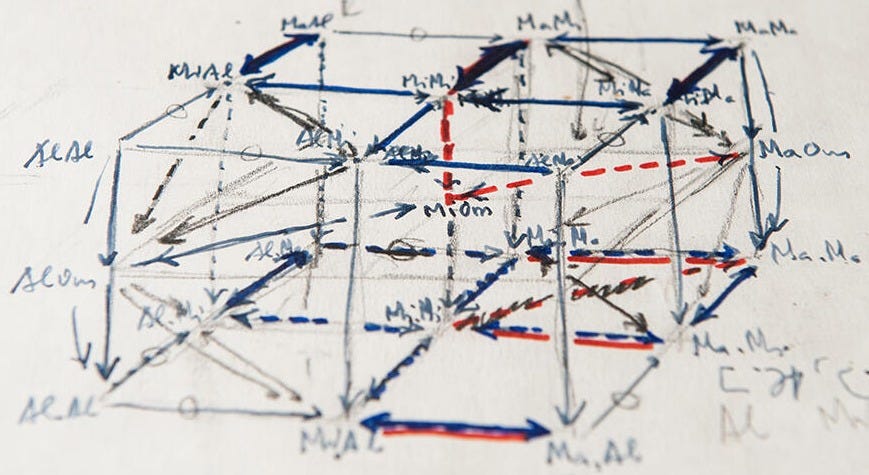
David Bessis — a former research mathematician who solved a real problem (the K(π,1) conjecture for complex reflection groups) and then left academia to found a machine-learning startup — argues that math has long misunderstood itself. Its true value, he says, is concept-building and intelligibility: elevating human understanding. But its reward system pays for something narrower. He calls it the "theorem economy" — hard proofs confer status, definitions score zero points, and expository work counts as negative. That honor code was productive, and it built a structural weakness: if only theorem-proving confers status, and an AI masters theorem-proving, humans become professionally obsolete.
He sharpens it with a pair of coinages. Mathlib is canonized, human-curated, intelligible formal math. Mathslop is AI-generated proof that is correct and unreadable — he points to autoformalization producing 200,000-line outputs no human comprehends. And he warns of the "Overhang": results latent in existing literature, derivable by connecting what's already known, exactly the terrain where large models excel and where they can front-run mathematicians without producing any understanding. His prescription is urgent public repositioning — sell the discipline as being about clarity, not problem-solving — or watch funding and students evaporate.
The thread took both exits
One reader simply declined the alarm:
"As someone who isn't a mathematician, the main value I get out of math is its practical applications… If AI systems start churning out accurate theorem-proofs, and we are able to use those theorems to build things that improve human quality of life, it doesn't bother me one bit that those theorems have not been understood by humans." — a self-described non-mathematician who values math for what it builds
Another gave the argument a political name:
"maybe also incredibly naive politically? it's like he's re-discovering alienation under capitalism. A wood-worker could do the same argument… But now comes techo-capitalism, division of labor… fuck your human element, we want that profit!" — a reader reframing the essay as rediscovered alienation
And the most literary response found the map already drawn in fiction — with a caveat that doubles as a lifeline:
"Greg Egan's description of how mathematics evolves into "truth mining" in his novel Diaspora is seeming more and more prescient… Current-gen LLMs are still relatively weak at visual reasoning… So that's one way humans can stay ahead of the agents, at least for now." — a reader citing Egan and the "Vision Language Models are Blind" paper
That "at least for now" is the whole game. Bessis isn't really predicting math will die; he's predicting the part of it that pays will move to machines, and betting the part that survives — understanding, intuition, the visual leap the models can't yet make — is the part the profession spent three centuries scoring at zero.
Get breakdowns like this every day
The top Hacker News stories, unpacked — by email, Telegram, or RSS.
How to ask a stranger for help — and why 100 handwritten notes got zero replies
Pradyu Prasad's rule is one line: put yourself in the other person's mind. The corollary, learned the hard way by a reader in the thread, is that effort you pour in to look sincere can be the exact thing that buries your ask.