Tag

Lean

7 stories

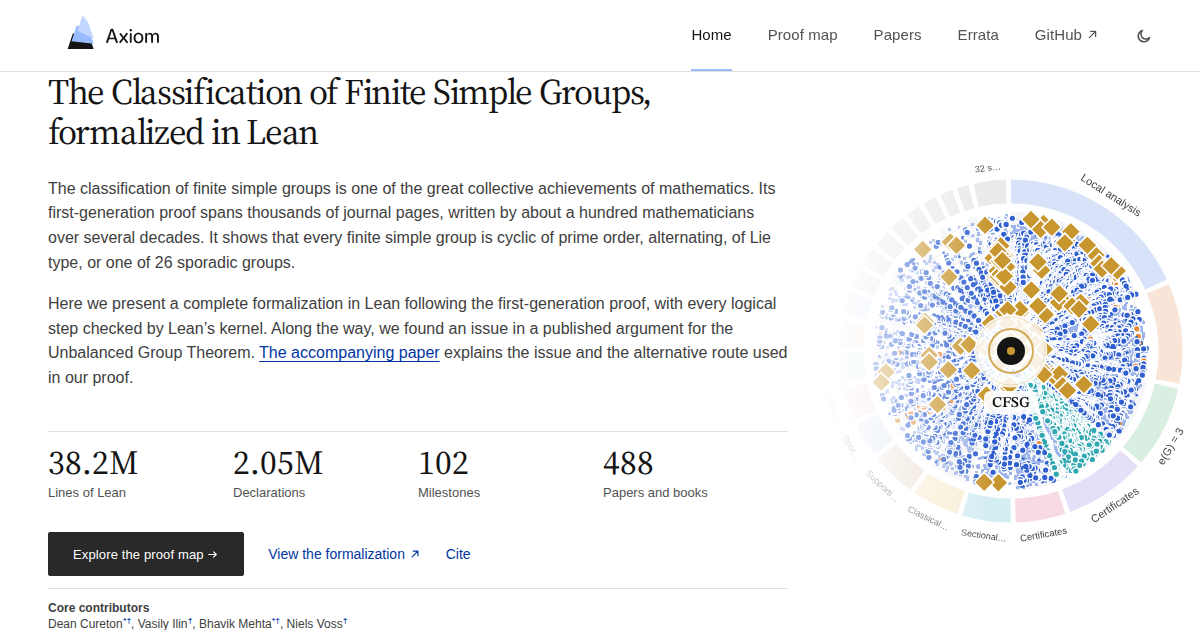
Lean has checked all 43.1 million lines of the finite simple groups classification, and found one gap (cfsg.axiommath.ai)

Every logical step of the classification, the theorem that every finite simple group is cyclic of prime order, alternating, of Lie type or one of 26 sporadic groups, was checked by Lean's kernel. The formalization has 2.05 million declarations and 100 milestones, and the team published an alternative route for the affected case.

Mathematicians in the thread were surprised the count was so low.
Not just a headline — the discussion unpacked

The top HN threads: facts from the discussions, both sides, insider voices. Email, Telegram, or RSS.

An expert vouched for an AI's multiplication breakthrough without reading its proof (web.maths.unsw.edu.au)

The claimed gain is a factor of (log n)^ε with ε = 2^-182, which the thread mocked as microscopic. Harvey calls it "gobsmackingly enormous": the first crack in a bound he had treated as a hard physical limit.

A game developer's reply on HN: "this does not feel like a healthy place to be."

OpenAI lists ten mathematical advances, and HN asks for the denominator (openai.com)

The announcement presents ten advances and says researchers helped prepare manuscripts and formalize proofs in Lean. That turns a model result into a claim about a research process, not just an answer.

HN’s sharpest question was what the release leaves uncounted: attempted problems, failed runs, repeated attempts, and the cost of the surrounding harness.

🚀Tech ★ 459 · 💬 727 · Aug 4 · #AI#programming#science#Lean#OpenAI

An AI disproved a century-old math conjecture during the World Cup final (xenaproject.wordpress.com)

PhD students are now expected to pay $200 a month for access to models like Sol and Fable — Harvard already comps the subscription for every student, postdoc and faculty member in its math department.

Not everyone in the thread is impressed: one commenter dug into the Jacobian conjecture's citation history and found mathematicians had already bounded the search space by 1983 — the AI didn't discover new territory, it just finally searched it.

A mathematician who quit academia says AI will kill the 'theorem economy' — and maybe save math (davidbessis.substack.com)

His distinction is Mathlib versus Mathslop: human-curated formal math you can understand, versus AI output that's correct and unreadable — a 200,000-line proof no one comprehends. If status flows only to proving, and machines prove best, mathematicians become obsolete.

The thread pushed back from two sides. A non-mathematician shrugged: if unreadable-but-correct theorems let us build useful things, who cares? Another reached for Greg Egan's 'truth mining' — and the one edge humans keep, for now: today's models are still weak at visual reasoning.