The US government quietly became a shareholder in 26 companies. Someone added it all up
Intel, MP Materials, U.S. Steel, Westinghouse, a wave of quantum startups: one newsletter counts about $23.9 billion of federal equity, price floors and off-take deals — a sovereign wealth fund nobody announced.
The move that recurs isn't a stock purchase — it's the off-take deal, where Washington becomes co-owner, co-funder and guaranteed customer at once. The MP Materials template: a stake plus a 10-year rare-earth price floor plus a promise to buy the output.
HN reached for every ideology at once — socialism, fascist corporatism, state capitalism. The most grounded voice wasn't reaching: a former Obama/Biden-adjacent policy hand, now a VC, called it bipartisan industrial policy with a long lineage, not an aberration.
A sovereign wealth fund, assembled without ever announcing one
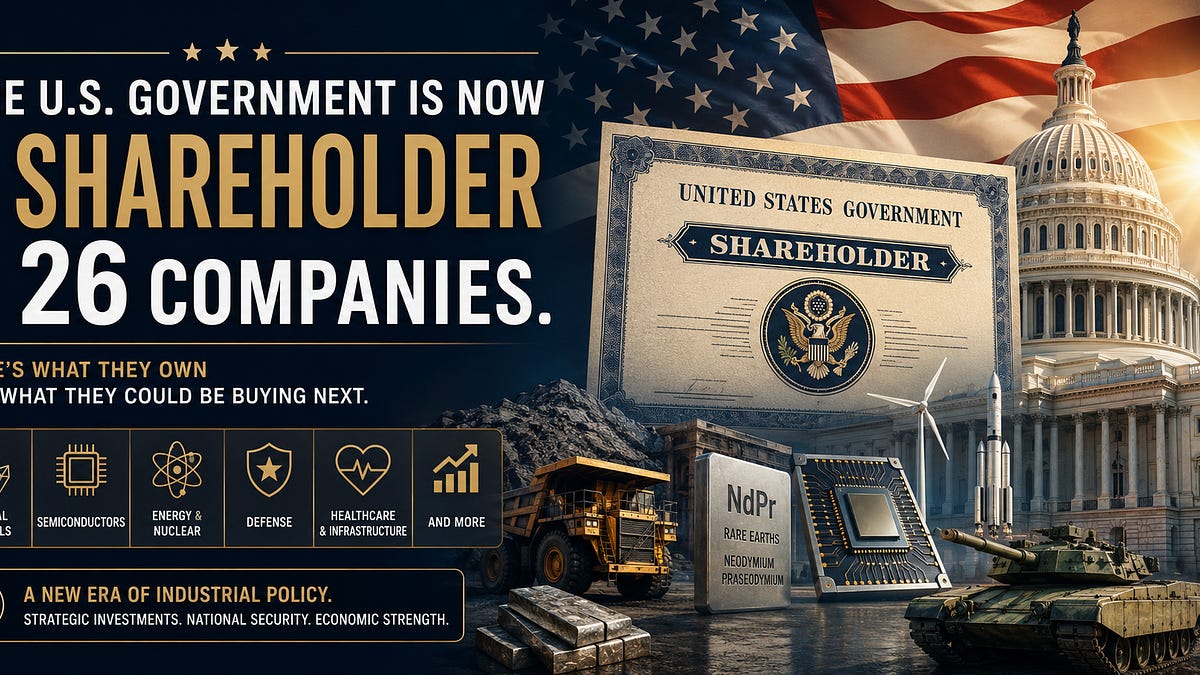
The thesis is that Washington has shifted from grant-maker to equity investor — running a sovereign wealth fund in all but name through a coordinated mix of direct stakes, stacked grants and loans, and off-take agreements that make the government co-owner, co-funder and guaranteed customer simultaneously. The newsletter counts roughly $23.9 billion deployed across 26 confirmed deals, against a legal ceiling raised to $205 billion (from $60 billion in December 2025), leaving about $181 billion of unused capacity, plus ~$4.75 billion of private co-investment from the likes of JP Morgan and Goldman.
The deals span sectors, and a few define the shape:
| Deal | Structure |
|---|---|
| Intel | ~$8.9B for a 9.9% equity stake, converting CHIPS Act grants into ownership plus warrants for ~240.5M more shares |
| MP Materials | Government as largest shareholder + a 10-year rare-earth (NdPr) price floor at $110/kg + a commitment to buy output |
| U.S. Steel | A "golden share" with veto power over major decisions — control, not cash-for-equity |
| Westinghouse | ~$80B structure with a participation interest above $17.5B and an option to force an IPO at a $30B valuation |
The author's own emphasis is that off-take — the guaranteed-customer piece — is "the most powerful and least discussed tool," and that MP Materials, not Intel, is the real template. One caution worth stating up front: the piece discloses it was researched and illustrated with AI tools, flagged in the thread, so the exact dollar figures deserve a second look before anyone quotes them as gospel.
The thread argued about the word before the numbers
The most useful correction was structural — this isn't one fund, it's many:
"it's not a centralized US Gov buying stakes. It's a bunch of different government entities using different pools of capital — Commerce dept: Intel, IBM quantum, GlobalFoundries… Dept of "war": MP Materials for rare earths… Energy dept: Lithium Americas… White House: U.S. Steel golden share" — an engineer who enumerated the deals by lead agency
The steadiest voice belonged to someone who'd worked near the policy machinery:
"There is bipartisan support for industrial policy. 2008 shaped our thinking on this… Our allies (Japan, South Korea) as well as our competitors (China) use this as well, and so did the US until the 1990s. I support the CHIPS Act and IRA. I also support building an American SWF." — a former Obama/Biden-adjacent policy hand, now a VC
The strongest objection wasn't about labels — it was about incentives:
"If the govt makes more money when intel is successful, then the govt is incentivized to sabotage Intel's competitors (e.g. through tariffs, export controls, and many other powers). This distorts the free market that is (allegedly) at the center of America's success." — a commenter on the conflict a state shareholder creates
That's the part the "is-it-socialism" shouting match keeps skipping. Once the government's balance sheet rises and falls with a specific company, its regulatory powers stop being neutral — and it acquires 181 billion reasons to keep going.
Get breakdowns like this every day
The top Hacker News stories, unpacked — by email, Telegram, or RSS.
OpenAI floated giving Washington a 5% stake — worth about $43 billion. The thread called it a moat, not a gift
According to the Financial Times, OpenAI proposed handing the US government 5% of the company — roughly $43 billion at its $852 billion valuation — and wants other AI labs to do the same. Sam Altman has also been talking to Bernie Sanders, who wants 50%.