Nvidia's $2 Billion Stake Covers Just 6% of CoreWeave's GPU Spending
CoreWeave plans to spend $31 billion to $35 billion on Nvidia GPUs this year, and is burning nearly twice as much cash as it earns to do it. Nvidia's own equity stake in the company: $2 billion, a rounding error next to the debt CoreWeave is taking on to keep building.
CoreWeave's first-quarter free cash flow came in at negative $4.71 billion even as revenue more than doubled. To close the gap, it raised $3.5 billion in new debt this week alone, on top of $24.86 billion already owed, with interest payments now eating over a quarter of revenue.
One HN reader ran the actual math: Nvidia's investment is only 5.7% of CoreWeave's yearly GPU budget, making it "hardly circular." The real story, he argued, is who is financing the other 94% and what happens when Treasury yields keep climbing.

Nvidia's $2 Billion Buys 9% of CoreWeave, Plus a Buyer-of-Last-Resort Clause
I/O Fund analyst Beth Kindig laid out, in a detailed breakdown, how Nvidia's money moves through the two biggest "neoclouds" — GPU-only cloud providers built to rent Nvidia hardware to AI labs. Nvidia put $2 billion into CoreWeave for a 9% stake and another $2 billion into Nebius. Those checks look modest next to what the two companies are actually spending: CoreWeave guided to $31–35 billion in 2026 capital expenditure, almost all of it Nvidia chips.
The part that makes it a financing story rather than a shopping story is a separate arrangement: Nvidia agreed to buy any unsold CoreWeave GPU capacity through April 2032, worth $6.3 billion. So Nvidia is simultaneously CoreWeave's equity investor, its main supplier, and the backstop that buys back capacity nobody else rents. Kindig's argument is that this loop works fine as long as demand keeps climbing — and gets expensive fast if it doesn't.
CoreWeave Borrows $5.40 for Every $1 It Raises in Equity
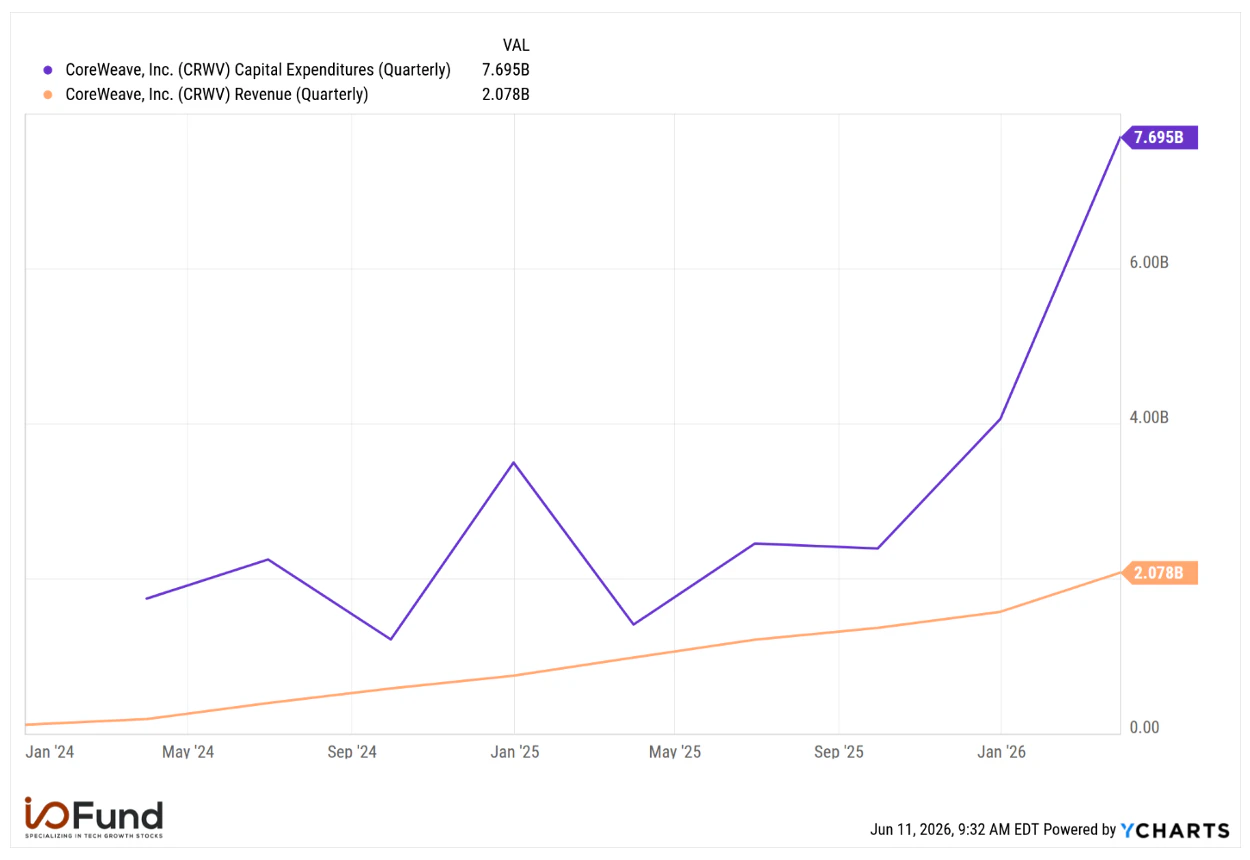
CoreWeave's Q1 2026 revenue hit $2.08 billion, up 112% year over year: a real business, not a shell. But the chart shows capex climbing faster than revenue every quarter: $7.7 billion spent in Q1 alone against $2.98 billion of operating cash flow, leaving free cash flow at -$4.71 billion for the quarter. The company's cash balance dropped 28% in three months.
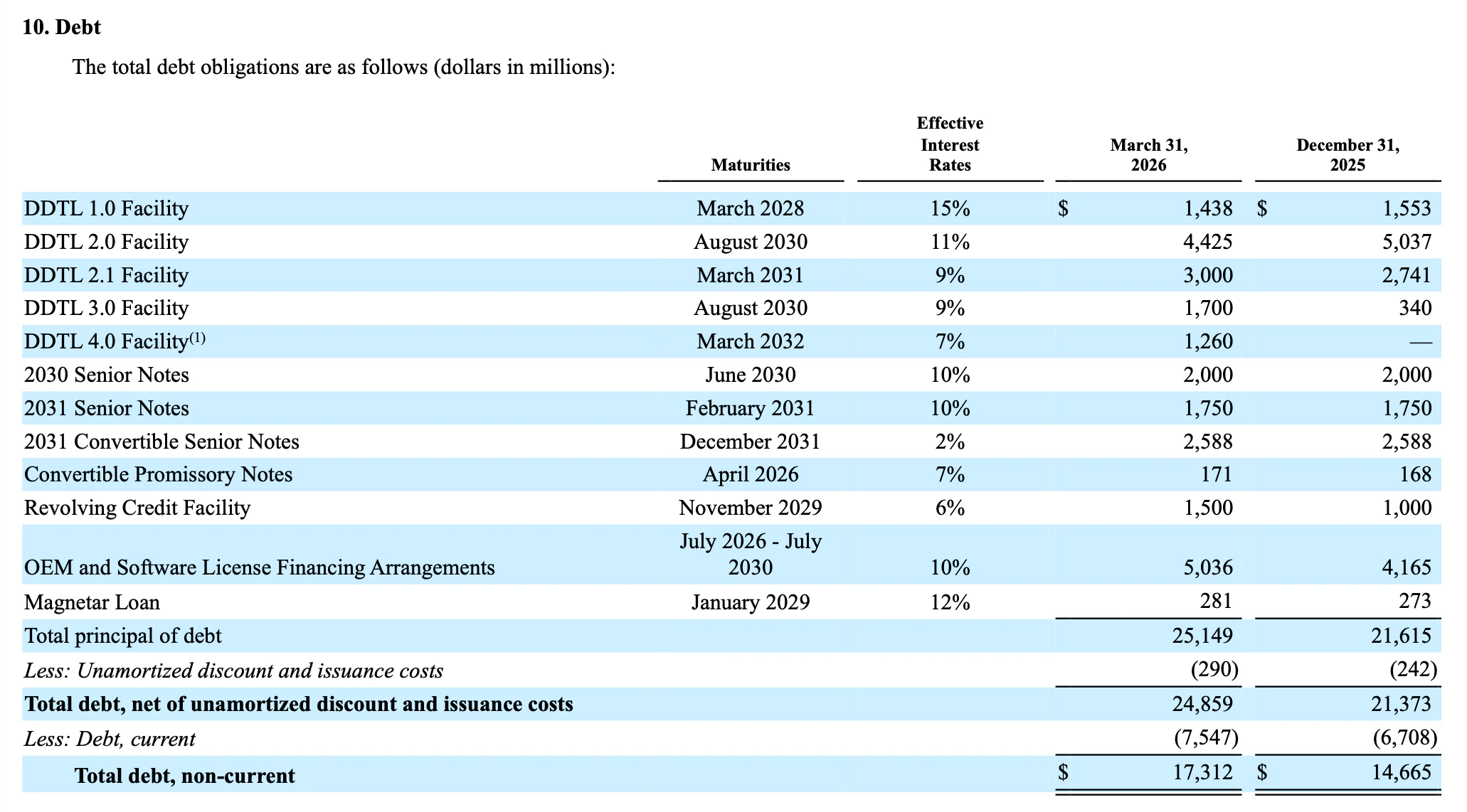
To close that gap, CoreWeave has leaned almost entirely on debt. Since its first earnings report as a public company, it has raised $3.5 billion in equity against $18.81 billion in debt, 5.4 times more borrowed than raised from shareholders. Total debt now stands at $24.86 billion, including two GPU-backed delayed-draw term loans (DDTLs, credit lines released in tranches as the borrower needs them): $8.5 billion at the DDTL 4.0 facility, priced at the three-year Treasury rate plus 2%, and a newer $3.1 billion DDTL 5.0 facility. On June 11, four days before Kindig's piece, CoreWeave announced another $3.5 billion senior note.
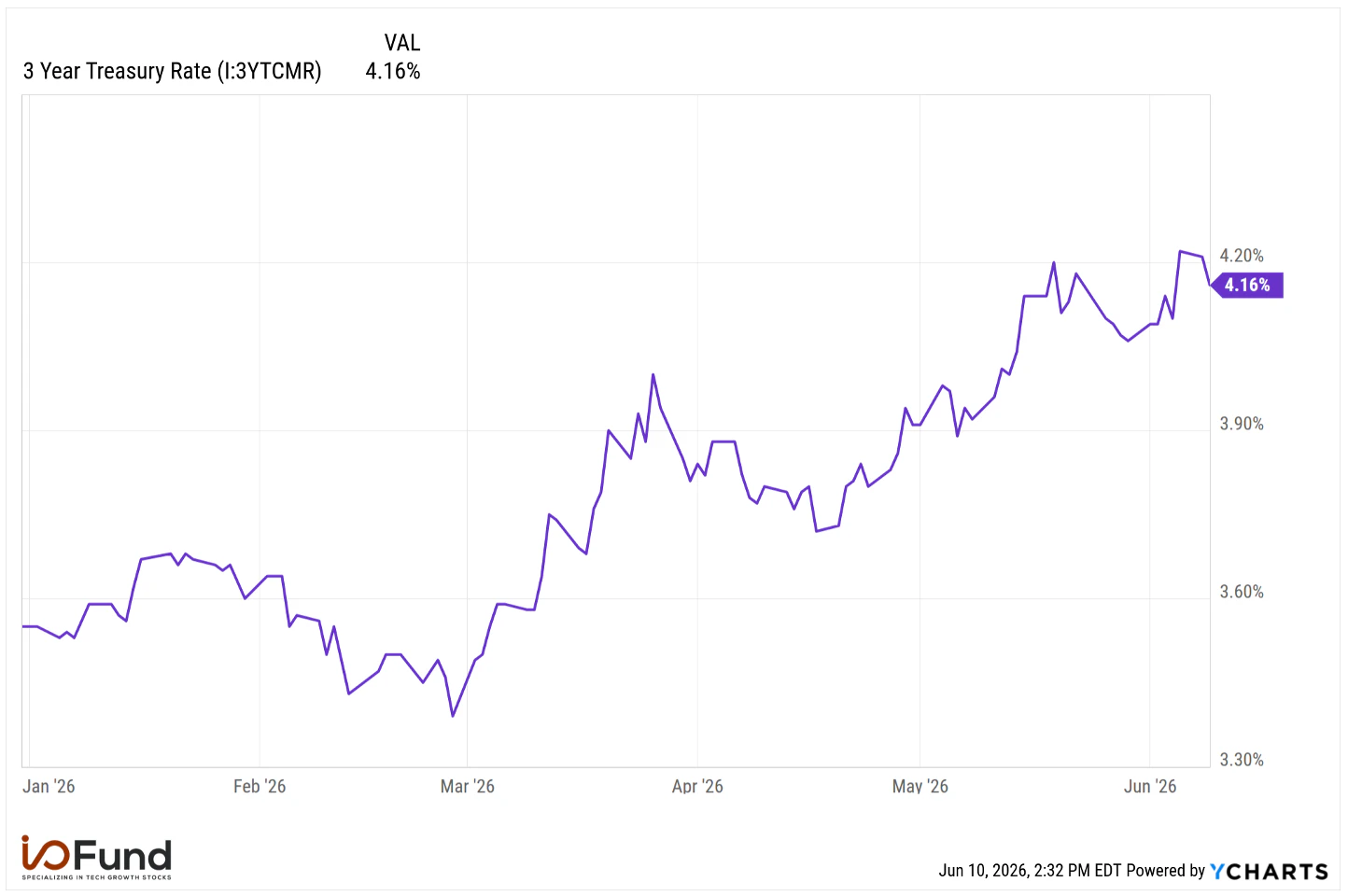
That debt has a price tag. CoreWeave paid $536 million in interest in Q1: 25.8% of revenue and 46.3% of adjusted EBITDA. Kindig projects Q2 interest expense at roughly $690 million, pushing the interest-to-revenue ratio to 27.3%. Every basis point the three-year Treasury yield moves matters directly: it sat below 3.6% in early 2026 and had climbed to 4.16% by June, and CoreWeave's DDTL rate is contractually pegged to it.
Nebius Runs the Same Playbook, With Cleaner Numbers So Far
Nebius, the Amsterdam-based cloud company that emerged from Yandex's international assets after Yandex sold its Russian operations for $5.4 billion in 2024, is growing even faster: Q1 revenue of $339 million, up 684% year over year, on a FY2026 guidance of $3.4 billion. Its capex plan is smaller in absolute terms, roughly $22.5 billion for 2026, and its balance sheet is still net-cash positive, unlike CoreWeave's.
| CoreWeave | Nebius | |
|---|---|---|
| FY2026 revenue (guidance) | $12.6B | $3.4B |
| FY2026 capex (guidance) | $31–35B | ~$22.5B |
| Total debt (latest quarter) | $24.86B | $8.45B |
| Net cash position | -$22.6B | +$920M |
| Q1 free cash flow | -$4.71B | -$214.9M |
| Remaining 2026 funding gap | $17.33B | $6.3B |
Nebius still needs roughly $6.3 billion more to fund its 2026 build-out, and it plans to raise part of that through an at-the-market share program: up to $5 billion at current prices, at roughly 8% dilution. Both companies are underwritten by hyperscaler demand that dwarfs their own balance sheets: Microsoft has committed some $60 billion in neocloud capacity across providers, and Meta alone is on the hook for $35.2 billion with CoreWeave and up to $27 billion with Nebius, a combined $122 billion close to 90% of Amazon Web Services' trailing annual revenue.
The Thread's Rebuttal: "Hardly Circular"
The loudest pushback on Hacker News wasn't about whether the debt is real. It was about whether "circular" is even the right word for what Nvidia actually put in. In the thread, a commenter with nearly 7,700 karma ran the numbers:
"Nvidia invested $2b into CoreWeave for 9% equity stake. CoreWeave is spending $35b in CapEx in 2026… Nvidia's investment is only 5.7% of CoreWeave's single year CapEx. The other $32b is coming from other sources that isn't Nvidia. This is hardly circular." — a commenter with nearly 7,700 karma
His read on motive: Nvidia backs neoclouds as a hedge against hyperscalers designing their own chips and sidelining Nvidia's rack architecture, while the neoclouds take Nvidia's money because it guarantees first access to new GPU generations, silicon that can run 5 to 20 times more efficiently than the previous one. Nvidia gets deployment data and a loyal reseller; the neocloud gets priority allocation. Neither side needs the other to be circular for the arrangement to make sense.
A different commenter flagged the metric everyone was skipping over: not whether the financing loops, but whether the spending will ever pay for itself: return on investment per token, enterprise token budgets, and the point at which capacity outpaces what anyone is willing to pay for it, especially as open-weight models push token prices down.
A Second Read: This Looks Like 2007, Just With GPUs Instead of Mortgages
Not everyone was reassured by the arithmetic. The bigger worry in the thread wasn't any single company's balance sheet. It was the size of the aggregate exposure now sitting across the AI industry's interlocking IOUs.
"All that circular investment, all the IOUs, all the billions of dollars of money that are floating around in the entire AI web… it will seriously wreck the US economy, the volume is orders of magnitude worse than what caused the 2007ff global financial crisis." — an HN member since 2013 with over 23,000 karma
Another reader offered a less alarming version of the same worry: financing bottlenecks, power delays, and permit backlogs are already slowing how fast CoreWeave and Nebius can actually build, which caps how much stranded, unused capacity will be sitting around if demand ever does cool off.
Nvidia's Real Leverage Isn't the Equity Check: It's Being the Only Supplier
The sharpest structural read in the thread wasn't about debt ratios at all. It was about what Nvidia's position actually is once you strip the investment headline away.
"…any company has to spend on NVIDIA assets for their compute. Now that makes NVIDIA rich and so they don't know what to do with their money. They are just propping up companies they find interesting" — an HN member with over 5,100 karma
That is the loop Kindig's numbers point to without quite naming it. CoreWeave and Nebius aren't raising debt because they're reckless: they're raising it because Nvidia's compute is the only compute worth having right now, and the DDTLs, senior notes, and dilution are the price of staying first in line for it. The Treasury-pegged interest rate is the one variable in the whole arrangement that nobody in this deal controls.
Get breakdowns like this every day
The top Hacker News stories, unpacked — by email, Telegram, or RSS.
Rescued after 55 years of slavery in Brazil, she has nowhere else to go
Maria entered a Brazilian household in 1971 and spent the next 55 years there unpaid, isolated from her own relatives, working for three generations of the same family. When authorities finally intervened this month, they didn't remove her — they let her stay, worried that after 55 years, freedom without support might do more harm than the enslavement itself.