Meta tied performance reviews to token spend. Engineers ran two agents to chat all day
To hit a metric that rewarded burning AI tokens, employees at one firm set two agents talking to each other all day. The author of the post calls this regime over — then predicts it comes back, smarter.
An essay argues tokenmaxxing died only because subsidized tokens got pricier, and that a coming shift it calls 'compounding correctness' — where spending more tokens reliably buys better answers — will resurrect it on cheaper open models.
The thread, full of people who sat in the VP meetings, was having none of the charitable read: one called it 'a moronic move fueled by hype', another reported being told to approve PRs without reading them.
The metric that paid engineers to waste tokens
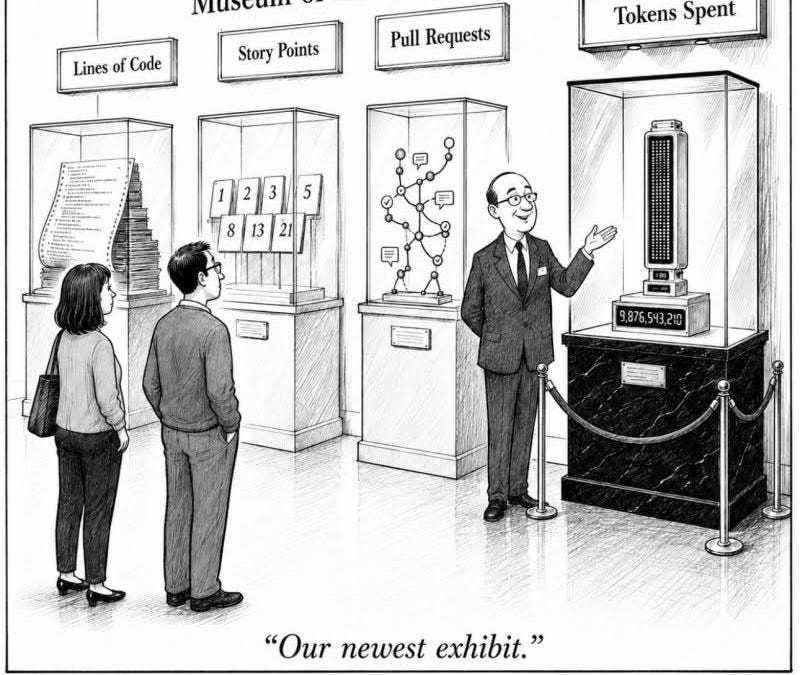
The essay by theahura, who writes at 12 Grams of Carbon, opens with a scene: a company tied performance reviews to token usage, so employees left two agents talking to each other through the workday to inflate the number. The author's term for this is tokenmaxxing — spending on AI tokens detached from any return.
His argument is that the practice only paused. The first wave died when still-subsidized tokens got slightly less subsidized and CFOs noticed they were burning money with no way to measure ROI. But he claims AI has crossed from compounding error — where one early mistake snowballs into failure — into compounding correctness, where each extra token spent on getting a task right raises the odds of a good result. If that holds, the spending becomes rational, and returns on cheaper open models like GLM 5.2 (around $1.40 per million input tokens, against Opus at $5 in / $25 out). Hence the title: dead, but not for the last time.
"Underperforming in token spend"
The thread split on a single question: was tokenmaxxing a deliberate change-management lever, or just hype? The opening comment defended it as a way to force reluctant staff to actually learn the tools. The people who'd watched it from inside rejected that flatly.
"having heard the arguments made by some VP + C-levels throughout the Tokenmaxxing Tulip Mania … 'to see if Programmer Joe can be as productive as the entire team so we can fire the rest'. And many indeed fired employees in droves because they were 'underperforming in token spend'." — herval, a thread regular who sat in the exec discussions
"It really wasn't. It was a moronic move fueled by hype, implemented by the same type of incompetent business leaders who previously … drank the blockchain and metaverse kool-aid." — a commenter invoking Goodhart's law
Not everyone agreed it was even real. One engineer said it sounded like noise from a handful of firms — until a reply landed the counterpoint with a number.
"I thought so too until the company I work just instated this where you have spend from 35-60K within 6 months. Insanity" — metaltyphoon, describing a mandate at his own employer
The flip nobody in the thread defended
The sharpest insider note came from someone running AI adoption at his own company, who turned the whole framing around: the danger isn't overspending, it's frugality.
"the bulk of our employees are stuck cost-maxing and literally cannot 'imagine how you are running into your session limits'. … There's a case for the cost-maxing has hurt our company." — linsomniac, a self-described AI lead pushing the tools internally
The maintainer of runc weighed in on why none of this surprises anyone who's worked in a large company:
"I'm also taken aback with how naive folks are about companies … Office Space came out 27 years ago and has a plotline making fun of overpaid 'efficiency consultants' whose only job is to tell management to fire people." — Aleksa Sarai, maintainer of runc and umoci
The most damning detail wasn't about tokens at all. It was what review now means once a metric replaces judgment:
"merging a PR still requires 2 humans to press 'Approve' but I've been instructed that I don't need to read the PR, I only need to click 'Approve'. This is what 30 years of SWE experience is being used for now." — leptons, a developer working since the early 1970s
That is the cost the essay's optimism skips. "Compounding correctness" assumes a human still checks the output; the thread's own evidence is that the checking is the first thing the metric culture quietly deletes.
Get breakdowns like this every day
The top Hacker News stories, unpacked — by email, Telegram, or RSS.
A year later, OpenAI Codex still can't be told to skip your .env file
Someone opened issue #2847 asking Codex for a simple .codexignore so the agent would never read .env, *.pem or .ssh keys. The thread's verdict: even if OpenAI shipped it, it would be security theater.