Tag

ClickHouse

4 stories

ClickHouse deleted a Postgres rewrite from its benchmark after finding per-query code in the binary (github.com)

ClickBench's maintainer removed pgrust, a Rust reimplementation of Postgres, saying its entry measured "a lookup table of the benchmark, not a database." Probes with slightly altered queries were refused with errors.

pgrust's creator showed up in the thread to say the accusations are false. Commenters wanted to know why the paths were in the binary.

Not just a headline — the discussion unpacked

The top HN threads: facts from the discussions, both sides, insider voices. Email, Telegram, or RSS.

ClickHouse turned PgBouncer's one CPU core into sixteen for 4x throughput (clickhouse.com)

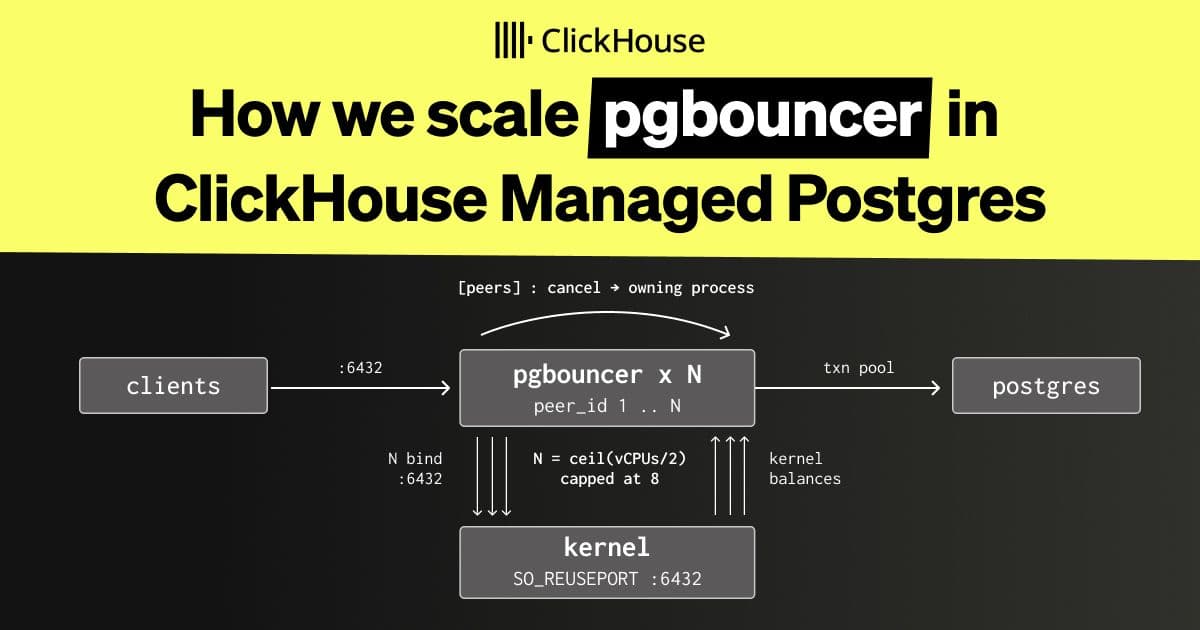
On a 16-vCPU box, one PgBouncer process topped out around 77,000 transactions per second at 256 clients while using under 8 percent of the machine. ClickHouse's Postgres team ran sixteen processes on the same port instead, using a kernel trick called so_reuseport, and throughput jumped to 336,000 — roughly 4x — with a fix for cancel requests that used to vanish into the wrong process. One reply in the thread was blunter: Yandex already ships a pooler built to do this natively, no patch required.

He indexed 45M Hacker News comments to chart 18 years of tech hype (hackernewstrends.com)

A solo dev fed the entire ~48GB Hacker News archive into a search index and built a date-histogram over 45 million posts and comments going back to 2007. Overlay any terms and the tech cycle plays out as a literal chart: lk-99's one-week spike, Stuxnet's lonely persistence, crypto handing the baton to chatgpt.

Then ClickHouse's lead developer dropped by to note he already hosts the same HN dataset as a public SQL database. And the sharpest voice warned it isn't Google Trends at all: it counts what people wrote, not what they searched.

A 16,000-line Rust parser written by Claude that the author never read (posthog.com)

The old parser interpreted an ANTLR grammar at runtime; the Rust rewrite is a recursive-descent parser with a Pratt expression core. It ran 70x faster on a laptop and 454x faster in production, with zero divergences across millions of shadow-mode queries.

The thread calls it the anti-vibe-coding playbook: an engineer who builds the same oracle setups says you can generate corpuses large enough to trust code you never read. A skeptic asks the question nobody answered: why not compile the grammar instead of fuzzing a code generator into agreement?