Tag

Linux

12 stories

Linux 7.3 ships with 18,765 commits and 807 first-time kernel contributors (lwn.net)

LWN calls Linux 7.3 a record-breaking release: 18,765 non-merge commits from 3,021 developers, 807 of them first-timers. The headline changes include a new fchroot() system call, per-CPU global data for BPF, and a finished sched_ext subscheduler.

There is also failfs, a filesystem that deliberately fails every operation, built for testing.

🚀Tech ★ 591 · 💬 276 · Oct 20 · #open source#programming#BPF#Linux#LWN+1

Not just a headline — the discussion unpacked

The top HN threads: facts from the discussions, both sides, insider voices. Email, Telegram, or RSS.

Leaving Android for Linux means trading polish for control (runarcn.no)

The author’s Android-to-Linux switch is a case for a phone that can be inspected and changed like a general-purpose computer. HN readers pointed to alternatives such as postmarketOS and Purism hardware, but also named what does not travel cleanly: services built around Google Play Services and Wallet.

The discussion’s disagreement was not whether Android contains open-source code. It was whether the experience can remain meaningfully open as important APIs and everyday features live in Google-controlled services.

A ripgrep crash points past the command line to the kernel (github.com)

The ripgrep issue reports crashes in musl-based binaries during very large searches. The thread quickly moved beyond a simple application bug and linked to an external analysis of the kernel behavior.

That shift matters because a fast command-line tool can be the first visible symptom of a defect beneath its own code, so reproductions and build details become evidence rather than noise.

🚀Tech ★ 251 · 💬 168 · Aug 2 · #dev tools#programming#Linux#musl#ripgrep

Nix wanted $ORIGIN in the kernel. It got eBPF-driven loader swaps instead. (fzakaria.com)

$ORIGIN is the token that tells a Linux loader to find dependencies relative to its own folder; ld.so has honored it for years. Nix wanted the kernel to honor it too, so packages stop hardcoding /nix/store paths: what landed instead swaps loaders through binfmt_misc via eBPF, overriding only PT_INTERP so /proc/self/exe still points at the real binary.

One catch surfaced fast: it needs root, since it can't run in an unprivileged namespace yet. And one commenter had already hand-built a similar userspace trick before this became a kernel feature.

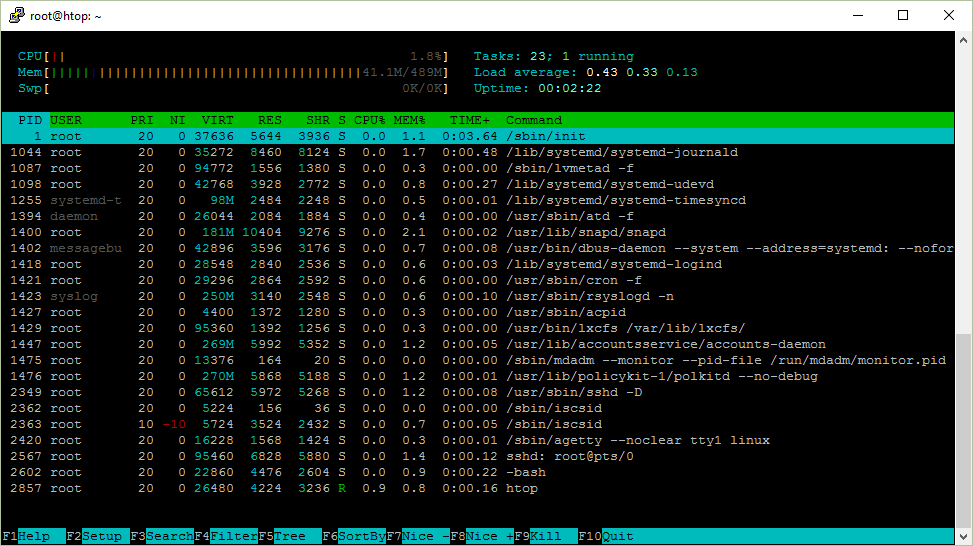
A field guide to every number in htop, from load average to zombies (peteris.rocks)

The 2019 explainer decodes every field in htop and top: load average as a damped average of runnable plus uninterruptible tasks, not CPU percent, and the S-state column from R to the unkillable D and the harmless Z zombie.

Its sharpest point: VIRT is an illusion. RES is the real resident memory; virtual size counts mmap'd regions a process never touches.

The comments turned it into a tools thread: btop, nmon, process-tree tweaks.

🚀Tech ★ 408 · 💬 53 · Jul 5 · #dev tools#programming#btop#htop#Linux+2

Ubicloud says the Linux OOM killer can drop every Postgres connection at once. Its own co-founder says the post oversells it (ubicloud.com)

The mechanism: Postgres backends share memory segments, so an OOM kill of one can force the postmaster to terminate every backend at once. Ubicloud's answer is strict overcommit (vm.overcommit_memory=2): Linux refuses over-limit allocations with ENOMEM, and Postgres cancels just the offending transaction.

The thread splits. A commenter says the article describes the kernel's overcommit modes wrong and ignores oom_score_adj; the company's own co-founder concedes the framing was too strong.

For two years, a Linux change left disk-encryption keys sitting in RAM through suspend (mathstodon.xyz)

The mechanism at issue is cryptsetup's luksSuspend, which is supposed to scrub the master key from memory before sleep. The claim: it quietly stopped, leaving the key resident and, in the post's words, 'for the taking by anyone who seized the still-powered laptop.'

The thread's corrections matter as much as the bug. Several readers noted luksSuspend is a Debian extension, so the headline overstates a kernel-wide flaw. Others questioned the threat model — a locked laptop isn't trivially readable by 'anyone' — and the most practical fix offered was to hibernate: power the RAM off and the whole class of cold-boot attack goes away.

🚀Tech ★ 415 · 💬 190 · Jul 3 · #open source#privacy#security#Debian#Linux#LUKS+1

He asked if you'd restarted your Mac this week. Cue an uptime culture war (taonaw.com)

A micro.blog writer described his weekly ritual of rebooting his Mac on Saturday mornings, force-quitting the unsaved-work warning for the small thrill of it. He isn't worried about losing anything: work syncs to OneDrive, files sync via Syncthing.

The 220-comment thread split by tribe. Linux and BSD users bragged about months of uptime and treated a forced reboot as a sign something is broken. A fleet admin countered from the trenches: it's pulling teeth to get 10,000 Windows users to accept one automated reboot a month.

🚀Tech ★ 115 · 💬 220 · Jul 1 · #culture#dev tools#programming#Linux#macOS#OVH+1

A blogger says Microsoft needs a $49 Windows Lite. Developers in the thread disagree (philipbohun.com)

Bohun argues that without builders there's no software and no users, so a clean Win32-only OS would win developers back and eventually replace mainline Windows while costing less to maintain. The price: $49, permanent, no subscription.

The catch several engineers flagged: dropping .NET guts one of the main things developers build on. Others said the product already exists quietly as LTSC, and that Microsoft wants you subscribed to OneDrive and Office, not buying a $49 disc once a decade.